At this point the economist PhD readers will scream: "this is total BS - after all you have bilateral netting which eliminates net bank exposure almost entirely." True: that is precisely what the OCC will say too. As the chart below shows, according to the chief regulator of the derivative space in Q2 netting benefits amounted to an almost record 90.8% of gross exposure, so while seemingly massive, those XXX trillion numbers are really quite, quite small... Right?
 |
| Add caption |
...Wrong. The problem with bilateral netting is that it is based on one massively flawed assumption, namely that in an orderly collapse all derivative contracts will be honored by the issuing bank (in this case the company that has sold the protection, and which the buyer of protection hopes will offset the protection it in turn has sold). The best example of how the flaw behind bilateral netting almost destroyed the system is AIG: the insurance company was hours away from making trillions of derivative contracts worthless if it were to implode, leaving all those who had bought protection from the firm worthless, a contingency only Goldman hedged by buying protection on AIG. And while the argument can further be extended that in bankruptcy a perfectly netted bankrupt entity would make someone else whole on claims they have written, this is not true, as the bankrupt estate will pursue 100 cent recovery on its claims even under Chapter 11, while claims the estate had written end up as General Unsecured Claims which as Lehman has demonstrated will collect 20 cents on the dollar if they are lucky.
The point of this detour being that if any of these four banks fails, the repercussions would be disastrous. And no, Frank Dodd's bank "resolution" provision would do absolutely nothing to prevent an epic systemic collapse.
...
Lastly, and tangentially on a topic that recently has gotten much prominent attention in the media, we present the exposure by product for the biggest commercial banks. Of particular note is that while virtually every single bank has a preponderance of its derivative exposure in the form of plain vanilla IR swaps (on average accounting for more than 80% of total), Morgan Stanley, and specifically its Utah-based commercial bank Morgan Stanley Bank NA, has almost exclusively all of its exposure tied in with the far riskier FX contracts, or 98.3% of the total $1.793 trillion. For a bank with no deposit buffer, and which has massive exposure to European banks regardless of how hard management and various other banks scramble to defend Morgan Stanley, the fact that it has such an abnormal amount of exposure (but, but, it is "bilaterally netted" we can just hear Dick Bove screaming on Monday) to the ridiculously volatile FX space should perhaps raise some further eyebrows...

Average:
4.97059
Your rating: None Average: 5 (34 votes)
Similar Articles You Might Enjoy:
Fitch: Financial Companies Hold 99.7% Of All Derivative Contracts
How Goldman's Counterparty Valuation Adjustment (CVA) Desk Saved The Firm From An AIG Blow Up (And Opens Up A Whole New Can Of Wormy Questions)
The Real "Margin" Threat: $600 Trillion In OTC Derivatives, A Multi-Trillion Variation Margin Call, And A Collateral Scramble That Could Send US Treasurys To All Time Records...
Is GS Tempting The Interest Rate Black Swan With 1,056% Risk Exposure?
Is GS Tempting The Interest Rate Black Swan With 1,056% Risk Exposure?
Sat, 09/24/2011 - 06:28 |
 Motley Fool
Light the fuse. :P
Login or register to post comments
Sat, 09/24/2011 - 07:02 |
spiral_eyes 
denials to begin in 3..2.....1
"who is this zero hedge and why should we care??"
Login or register to post comments
Sat, 09/24/2011 - 08:12 |
max2205 
MS=AIG? Wow
Lol some agency needs to set exposure limits AND leverage limits. Right
Lol. The Fed is stupid
Login or register to post comments
Sat, 09/24/2011 - 09:46 |
disabledvet 
Insofar as Morgan Stanley is obviously not too big too fail (the famous "go fuck yourself" line from their CEO to Hank Paulson when as the high and mighty Goldman alum was deciding who to place Morgan Stanley with after he had placed Bear Stearns with JPMorgan. No offense of course!) then i can't see the problem with leverage. Because i don't want to see a repeat of 2008 however i to do have a problem with exposure--not because the failure of Morgan Stanley is going to bring down "the entire global financial system!" as the failure of Lehman brothers allegedly did (which is a total fallacy.) In that sense AIG is truly a case of too big to fail. We know from Hank Paulson's book the President...of the United States that is...literally blurted out "AN INSURANCE COMPANY?!" What you don't get is "the dollar amount required" pre-amble in this bookend to the "War on Terror." Obviously AIG still exists and still writes policies--it does so at the behest of American people and their interests there of. For those who think "blowing up banks" is a "cool and groovy think to do" i say this to you: in the end you may wish for that thing to fail because if it doesn't "they will remember you."
Login or register to post comments
Sat, 09/24/2011 - 11:26 |
Tunga 
"Obviously AIG still exists and still writes policies--it does so at the behest of American people and their interests there of." - disabledvet
Errt! AIG is beholden to US citizens; aka corporate entities that bare only a faint semblance to Americans.
Login or register to post comments
Sat, 09/24/2011 - 11:44 |
nope-1004 
When I was a kid, a trillion dollars seemed like a lot of money.
Just some Sat. AM humor. LOL.
Login or register to post comments
Sat, 09/24/2011 - 12:05 |
Pinto Currency 
The top six banks are sitting on the biggest A-bomb of all - the interest rate derivative bomb.
That's how they blew the debt and financial sector bubble. They forced interest rates down.
Login or register to post comments
Sat, 09/24/2011 - 15:33 |
Djirk 
I am not a big fan of guvMINT regulation, but time to step in boyz/girlz and fix this mess
Login or register to post comments
Sat, 09/24/2011 - 19:00 |
Ag Star 
If the guvMINT had done it's job and not deregulated the banking, insurance, finance industries we would not be here today. WHO THE FUCK POLICES THEMSELVES? The constitution was written to prevent this shit but Americans didn't pay attention while they dismantled it. They ain't gonna fix anything--they are breaking it intentionally because they are mere puppets--what rock have you been living under?
Login or register to post comments
Sat, 09/24/2011 - 19:38 |
Old Poor Richard 
Too big to fail.
Too big to jail.
TOO BIG TO BAIL.
I'm with Motley Fool. It is past time to regulate. Time to light the fuse on these shitheads. Find their biggest unhedged exposures and twist the knife, triggering payouts they can't afford so that they all implode. Make the ones with insured deposits firewall those infrastructure and assets to protect the government and the depositors. Make sure the branches are open the next morning. Also ensure the ordinary non-too-big-to-bail banks are given the liquidity to keep main stream afloat as lower Manhattan slides into the Laurentian Abyss.
Login or register to post comments
Sun, 09/25/2011 - 04:40 |
AmCockerSpaniel 
I don't want the banks to fail. I do want the CEO's & COO's to do 20 ~ life .
Login or register to post comments
Sat, 09/24/2011 - 12:20 |
Kayman 
" only Goldman hedged by buying protection ON AIG." Goldman held a policy from the Bank of Hank. Hank, in turn, covered the bet through the daylight robbery of the American people.
America's industrial might once financed the parasitical Wall Street patty cake "industry".
Do you seriously believe that Wall Street is going to revive America ? Bonuses all around translated is "get out of Dodge"
Deficits and money printing are future claims that require careful investments in future earning assets, not squandering on pump and dump, churn and burn, jobs for the boys schemes.
Login or register to post comments
Sat, 09/24/2011 - 16:00 |
robertocarlos Hank is number one in the hood. He'll be the first to pay.
Login or register to post comments
Sat, 09/24/2011 - 11:16 |
Seize Mars 
MS=AIG? Wow
Lol some agency needs to set exposure limits AND leverage limits. Right
Lol. The Fed is stupid
No, they just need to stop asking taxpayers for a backstop. There is nothing wrong with grownups getting in over their heads - as long as they are the only ones who would pay...
Login or register to post comments
Sat, 09/24/2011 - 13:07 |
eisley79 the people who did it definitely wont ever pay. But the whole world is going to feel the result, its only a matter of time. They will asset/value strip for all they are worth, as long as they can...
Login or register to post comments
Sat, 09/24/2011 - 19:09 |
Ag Star They'll pay if we make them pay. Like the French did with the guillotine. " When people lose everything and have nothing left to lose--THEY LOSE IT"...Gerald Celente These people mus be identified and hunted down and made examples--like King Luis and his BFF Marie in addition to thousand of "aristocrats" like Buffet, Bernanke, Paulson.
Login or register to post comments
Sun, 09/25/2011 - 00:39 |
RockyRacoon 
I'm a generous person. I'd settle for all the sonsabitches to be flat broke living in a cardboard box under the nearest overpass. Just so long as we get to pass by velvet rope reception lines and watch them suffer.
Login or register to post comments
Sat, 09/24/2011 - 17:03 |
Stoploss 
More like to big to survive..
Login or register to post comments
Sat, 09/24/2011 - 08:14 |
Oh regional Indian 
Financial Engineering and Financial innovation, madness!
Once re-insurance became a fad, there was only one way to go, Downhill. Because even the thinnest tail could only be sliced in so many ways. And the farther you reached into it, the more unstable the re-re-re-re-re-re insurance pyramid structure became.
And now, with 6 sigma firmly in the Rear view mirror, all of this risk pyramid money making nonssense will finally crash. I see it like a rubber band, snapping back to the new new normal.
Mourge on Stanley, mourge on.
ORI
Uppers and Downers
Login or register to post comments
Sat, 09/24/2011 - 08:48 |
trampstamp 
Agreed. Everyone is coming over to ZeroHedge. I remember I use to visit a site called daytradingradio[.]com many months ago and used to quote ZH in their membership chat. Basically they were references to TD posts regarding how bad financially the globe was and to be prepared for a downturn. But these guys on there were full tard bullish and basically shrugged me off. The other day I just so happened to stop by to see how they were doing and I shit you not the main guy Dave was quoting ZH... Almost like an addiction he would go to ZH every few minutes to see what TD was pumping out. I just laughed. Just in case those shills are reading this... Glad you guys finally made it here.... - rander.
Login or register to post comments
Sat, 09/24/2011 - 09:59 |
citrine 
They would say "some blogger"
Login or register to post comments
Sat, 09/24/2011 - 11:44 |
RSloane 
I have absolutely no doubt that a website with this amount of traffic and nature of the participants is read by politicians and their staff, as well as financial players.
Login or register to post comments
Sat, 09/24/2011 - 12:14 |
Prometheus418 
A good reason to post comments.
What, did you think "voting" was going to do anyone any good?
Login or register to post comments
Sat, 09/24/2011 - 17:38 |
Dingleberry Voting just make one "feel" like they are part of the process. TPTB love that. Once folks get wise and realize they are NOTHING BUT PAWNS, and their supposed "team" of blue or red is primarily responsible to deliver their respective constituencies to whover pays them off with bribes (campaign contributions). Once folks stop voting, the jig will be up. And then TPTB will be very concerned, to say the least.
Login or register to post comments
Sat, 09/24/2011 - 13:47 |
newworldorder RE: RSloane
Not read by Obamer or the Congressional leadership. Too far below their pay grade to bother.
Login or register to post comments
Sat, 09/24/2011 - 09:13 |
Reggie Middleton 
Hey, there ain't no concentration risk in US banks, and any blogger with two synapses to spark together should know this...
An Independent Look into JP Morgan.

Cute graphic above, eh? There is plenty of this in the public preview. When considering the staggering level of derivatives employed by JPM, it is frightening to even consider the fact that the quality of JPM's derivative exposure is even worse than Bear Stearns and Lehman‘s derivative portfolio just prior to their fall. Total net derivative exposure rated below BBB and below for JP Morgan currently stands at 35.4% while the same stood at 17.0% for Bear Stearns (February 2008) and 9.2% for Lehman (May 2008). We all know what happened to Bear Stearns and Lehman Brothers, don't we??? I warned all about Bear Stearns (Is this the Breaking of the Bear?: On Sunday, 27 January 2008) and Lehman ("Is Lehman really a lemming in disguise?": On February 20th, 2008) months before their collapse by taking a close, unbiased look at their balance sheet. Both of these companies were rated investment grade at the time, just like "you know who". Now, I am not saying JPM is about to collapse, since it is one of the anointed ones chosen by the government and guaranteed not to fail - unlike Bear Stearns and Lehman Brothers, and it is (after all) investment grade rated. Who would you put your faith in, the big ratings agencies or your favorite blogger? Then again, if it acts like a duck, walks like a duck, and quacks like a duck, is it a chicken??? I'll leave the rest up for my readers to decide.
This public preview is the culmination of several investigative posts that I have made that have led me to look more closely into the big money center banks. It all started with a hunch that JPM wasn't marking their WaMu portfolio acquisition accurately to market prices (see Is JP Morgan Taking Realistic Marks on its WaMu Portfolio Purchase? Doubtful! ), which would very well have rendered them insolvent - particularly if that was the practice for the balance of their portfolio as well (see Re: JP Morgan, when I say insolvent, I really mean insolvent). I then posted the following series, which eventually led to me finally breaking down and performing a full forensic analysis of JP Morgan, instead of piece-mealing it with anecdotal analysis.
The Fed Believes Secrecy is in Our Best Interests. Here are Some of the Secrets
Why Doesn't the Media Take a Truly Independent, Unbiased Look at the Big Banks in the US?
As the markets climb on top of one big, incestuous pool of concentrated risk...
Any objective review shows that the big banks are simply too big for the safety of this country
Why hasn't anybody questioned those rosy stress test results now that the facts have played out?
You can download the public preview here. If you find it to be of interest or insightful, feel free to distribute it (intact) as you wish.
 JPM Public Excerpt of Forensic Analysis Subscription 2009-09-18 00:56:22 488.64 Kb
Login or register to post comments
Sat, 09/24/2011 - 09:42 |
Reggie Middleton ...Wrong. The problem with bilateral netting is that it is based on one massively flawed assumption, namely that in an orderly collapse all derivative contracts will be honored by the issuing bank (in this case the company that has sold the protection, and which the buyer of protection hopes will offset the protection it in turn has sold). The best example of how the flaw behind bilateral netting almost destroyed the system is AIG: the insurance company was hours away from making trillions of derivative contracts worthless if it were to implode, leaving all those who had bought protection from the firm worthless, a contingency only Goldman hedged by buying protection on AIG. And while the argument can further be extended that in bankruptcy a perfectly netted bankrupt entity would make someone else who on claims they have written, this is not true, as the bankrupt estate will pursue 100 cent recovery on its claims even under Chapter 11, while claims the estate had written end up as General Unsecured Claims which as Lehman has demonstrated will collect 20 cents on the dollar if they are lucky.
The point of this detour being that if any of these four banks fails, the repercussions would be disastrous. And no, Frank Dodd's bank "resolution" provision would do absolutely nothing to prevent an epic systemic collapse.
Super, Duper, B-I-N-G-0!!! It is so relieving to hear someone else espouse what really should be common damn sense, yet happens to be one of the uncommon commodities to be found on the Isle of Manhattan.
Login or register to post comments
Sat, 09/24/2011 - 10:20 |
spiral_eyes Word, Reggie.
Here on Zero Hedge we appreciate what you do.
Login or register to post comments
Sat, 09/24/2011 - 11:37 |
nope-1004 Here here!
Thanks Reggie.
Login or register to post comments
Sat, 09/24/2011 - 14:15 |
P Rankmug 
Any problems discussed above have already been taken care of under the National Security umbrella. What this means, if institutions like J.P. Morgan are deemed to be integral to U.S. National Security - they could be "legally" excused from reporting their true financial condition.
Intelligence Czar Can Waive SEC Rules,
"President George W. Bush has bestowed on his [then] intelligence czar, John Negroponte, broad authority, in the name of national security, to excuse publicly traded companies from their usual accounting and securities-disclosure obligations. Notice of the development came in a brief entry in the Federal Register, dated May 5, 2006, that was opaque to the untrained eye."
http://www.businessweek.com/bwdaily/dnflash/may2006/nf20060523_2210.htm?...
Login or register to post comments
Sun, 09/25/2011 - 05:58 |
jeff montanye thank you. nice to see five year old news that is still unknown, at least to me. they just never quit do they?
Login or register to post comments
Sat, 09/24/2011 - 13:38 |
Hulk 
Great Job Reggie. I always figured bi lateral netting was a croc of shit based on the AIG experience. I thank you for the education you and zh have afforded me...
Login or register to post comments
Sat, 09/24/2011 - 16:04 |
FinalCollapse Reggie - it is high time for you to learn a difference between trillion and billion. If you still don't get it - then please return to the Elementary school to take some math classes. This is third time I see this factual error presented by you.
Please kindly read your own presentation, looking for the word 'billion'. See - it does not make sense. The chart that you borrowed has unit of million.
I like your presentations, but you have no shame to repeat the same errors. These are facts - you confuse billions with trillions, and you do repeatedly. I feel sorry for the folks who pay for your advice.
Do you still have problem understanding your errros - please contact me offline, and I can explain it to you.
80,000,000 millions is 80 trillions, not 80 billions.
Login or register to post comments
Sun, 09/25/2011 - 06:06 |
jeff montanye thanks, good point. the main graph about jpm gross derivatives exposure vs. world gnp is really far more disturbing than reggie's description of it. but like his difficulty with imperfect verbs (have went) it doesn't really undercut his conclusions, though it does make him less acceptable in the mainstream world.
Login or register to post comments
Sat, 09/24/2011 - 09:32 |
Reggie Middleton Oh yeah, and while we're at it, this Morgan Stanley thing has been a concern of mine for well over a year now. The interest rate storm is coming, that is unless Europe can maintain historically low rates as several countries default. Then again, they never default, right...
Don't belive me, let's look at history...


So, as I was saying...
Check this out, from "On Morgan Stanley's Latest Quarterly Earnings - More Than Meets the Eye???" Monday, 24 May 2010:
Those who don't subscribe should reference my warnings of the concentration and reliance on FICC revenues (foreign exchange, currencies, and fixed income trading). Morgan Stanley's exposure to this as well as what I have illustrated in full detail via the the Pan-European Sovereign Debt Crisis series, has increased materially. As excerpted from "The Next Step in the Bank Implosion Cycle???":
The amount of bubbliciousness, overvaluation and risk in the market is outrageous, particularly considering the fact that we haven't even come close to deflating the bubble from earlier this year and last year! Even more alarming is some of the largest banks in the world, and some of the most respected (and disrespected) banks are heavily leveraged into this trade one way or the other. The alleged swap hedges that these guys allegedly have will be put to the test, and put to the test relatively soon. As I have alleged in previous posts (As the markets climb on top of one big, incestuous pool of concentrated risk... ), you cannot truly hedge multi-billion risks in a closed circle of only 4 counterparties, all of whom are in the same businesses taking the same risks.
Click to expand!

So, How are Banks Entangled in the Mother of All Carry Trades?
Trading revenues for U.S Commercial banks have witnessed robust growth since 4Q08 on back of higher (although of late declining) bid-ask spreads and fewer write-downs on investment portfolios. According to the Office of the Comptroller of the Currency, commercial banks' reported trading revenues rose to a record $5.2 bn in 2Q09, which is extreme (to say the least) compared to $1.6 bn in 2Q08 and average of $802 mn in past 8 quarters.

High dependency on Forex and interest rate contracts
Continued growth in trading revenues on back of growth in overall derivative contracts, (especially for interest rate and foreign exchange contracts) has raised doubt on the sustainability of revenues over hear at the BoomBustBlog analyst lab. According to the Office of the Comptroller of the Currency, notional amount of derivatives contracts of U.S Commercial banks grew at a CAGR of 20.5% to $203 trillion by 2Q-09 from $87.9 trillion in 2004 with interest rate contracts and foreign exchange contracts comprising a substantial 84.5% and 7.5% of total notional value of derivatives, respectively. Interest rate contracts have grown at a CAGR of 20.1% to $171.9 trillion between 4Q-04 to 2Q-09 while Forex contracts have grown at a CAGR of 13.4% to $15.2 trillion between 4Q-04 to 2Q-09.
In terms of absolute dollar exposure, JP Morgan has the largest exposure towards both Interest rate and Forex contracts with notional value of interest rate contracts at $64.6 trillion and Forex contracts at $6.2 trillion exposing itself to volatile changes in both interest rates and currency movements (non-subscribers should reference An Independent Look into JP Morgan, while subscribers should reference
JPM Report (Subscription-only) Final - Professional, and JPM Forensic Report (Subscription-only) Final- Retail). However, Goldman Sachs with interest rate contracts to total assets at 318.x and Forex contracts to total assets at 11.2x has the largest relative exposure (see Goldman Sachs Q2 2009 Pre-announcement opinion 2009-07-13 00:08:57 920.92 Kb, Goldman Sachs Stress Test Professional 2009-04-20 10:06:45 4.04 Mb, Goldman Sachs Stress Test Retail 2009-04-20 10:08:06 720.25 Kb,). As subscribers can see from the afore-linked analysis, Goldman is trading at an extreme premium from a risk adjusted book value perspective.
As a result of a surge in interest rate and Forex contracts, dependency on revenues from these products has increased substantially and has in turn been a source of considerable volatility to total revenues. As of 2Q-09 combined trading revenues (cash and off balance sheet exposure) from Interest rate and Forex for JP Morgan stood at $2.4 trillion, or 9.5% of the total revenues while the same for GS and BAC (subscribers, see
BAC Swap exposure_011009 2009-10-15 01:02:21 279.76 Kb) stood at $(196) million and $433 million, respectively. As can be seen, Goldman's trading teams are not nearly as infallible as urban myth makes them out to be.
Although JP Morgan's exposure to interest rate contracts has declined to $64.5 trillion as of 2Q09 from $75.2 trillion as of 3Q07, trading revenues from Interest rate contracts (cash and off balance sheet position) have witnessed a significant volatility spike and have increased marginally to $1,512 in 2Q09 compared with $1,496 in 3Q07. Although JPM's Forex exposure has decreased from its peak of $8.2 trillion in 3Q08, at $3.2 trillion in 2Q09 the exposure is still is higher than 3Q07 levels. Even for Bank of America and Citi , the revenues from Interest rate and forex products have been volatile despite a moderate reduction in overall exposure. With top 5 banks having about 97% market share of the total banking industry notional amounts as of June 30, 2009, the revenues from trading activities for these banks are practically guaranteed to be highly volatile in the event of significant market disruption - a disruption aptly described by the esteemed Professor Roubini as a rush to the exit in the "Mother of All Carry Trades" as the largest macro experiment in the history of this country starts to unwind, or even if the participants in this carry trade think it is about to start to unwind.
The table below shows the trend in trading revenues from Interest rate and Forex positions for top banks in U.S.
Click to enlarge...

Banks exposure to interest rate and foreign exchange contracts
With volatility in currency markets exploding to astounding levels (with average EUR-USD volatility of 16.5% over the past year (September 2008-09) compared to 8.9% over the previous year), commercial and investment banks trading revenues are expected to remain highly unpredictable. This, coupled with huge Forex and Interest rate derivative exposure for major commercial banks, could trigger a wave of losses in the event of significant market disruptions - or a race to the exit door of this speculative carry trade. Additionally most of these Forex and Interest rate contracts are over-the-contract (OTC) contracts with 96.2% of total derivative contracts being traded as OTC. This means no central clearing, no standardization in contracts, the potential for extreme opacity in pricing, diversity in valuation as well as a dearth of liquidity when it is most needed - at the time when everyone is looking to exit. Goldman Sachs has the largest OTC traded contracts with 98.5% of its derivative contracts traded over the counter. With the 5 largest banks representing 97% of the total banking industry notional amount of derivatives and most of these contracts being traded off exchange, the effectiveness of derivatives as a hedging instrument raises serious questions since most of these banks are counterparty to one another in one very small, very tight circle (see the free article, "As the markets climb on top of one big, incestuous pool of concentrated risk... ").

The table below compares interest rate contracts and foreign exchange contracts for JPM, GS, Citi, BAC and WFC.
JP Morgan has the largest exposure in terms of notional value with $64,604 trillion of notional value of interest rate contracts and $6,977 trillion of notional value of foreign exchange contracts. In terms of actual risk exposure measured by gross derivative exposure before netting of counterparties, JP Morgan with $1,798 bn of gross derivative receivable, or 21.7x of tangible equity, has the largest gross derivative risk exposure followed by Bank of America ($1,760 bn, or 18.1x). Bank of America with $1,393 bn of gross derivatives relating to interest rate has the highest exposure towards interest rate sensitivity while JP Morgan with $154 bn of Foreign exchange contracts has the highest exposure from currency volatility. We have explored this in forensic detail for subscribers, and have offered a free preview for visitors to the blog: (
JPM Public Excerpt of Forensic Analysis Subscription 2009-09-18 00:56:22 488.64 Kb), which is free to download, and JPM Report (Subscription-only) Final - Professional, or JPM Forensic Report (Subscription-only) Final- Retail as well as a free blog article on BAC off balance sheet exposure If a Bubble Bubble Bursts Off Balance Sheet, Will Anyone Be There to Hear It?: Pt 3 - BAC).

Subscribers, see
WFC Research Note Sep 2009 2009-09-30 13:01:30 281.29 Kb, ~ WFC Off Balance Sheet Exposure 2009-10-19 04:25:53 258.77 Kb ~ WFC Investment Note 22 May 09 - Retail 2009-05-27 01:55:50 554.15 Kb ~ WFC Investment Note 22 May 09 - Pro 2009-05-27 01:56:54 853.53 Kb ~ Wells Fargo ABS Inventory 2008-08-30 06:40:27 798.22 Kb to expound on our opinions of Wells Fargo, below.

Subscribers, see
MS Simulated Government Stress Test 2009-05-05 11:36:25 2.49 Mb and MS Stess Test Model Assumptions and Stress Test Valuation 2009-04-22 07:55:17 339.99 Kb Login or register to post comments
Sat, 09/24/2011 - 09:55 |
disabledvet "Even at a penny Lehman still trades." Move along.
Login or register to post comments
Sat, 09/24/2011 - 11:54 |
gmrpeabody 
Yes.., but what does it all mean, Reggie?
Login or register to post comments
Sat, 09/24/2011 - 13:06 |
Kayman gmrpeabody
" you cannot truly hedge multi-billion risks in a closed circle of only 4 counterparties, all of whom are in the same businesses taking the same risks"
Summary for you...
Login or register to post comments
Sat, 09/24/2011 - 13:34 |
slewie the pi-rat 
duh
but hadn't tyler already intimated that point? reggie is trolling & needs to keep his reasearch papers "above the line" where we can ignore him and not have him interfere with luddites and people w/ slower download situ's who want to read the blogs w/out having their systems jam due to r.m.'s head being terminally impacted
Login or register to post comments
Sat, 09/24/2011 - 20:23 |
Kayman Hi Slewie the pie-rat, of the 230 IQ, self-measured of course.
Login or register to post comments
Sun, 09/25/2011 - 06:11 |
jeff montanye and, as per above, isn't the risk multi trillion (a trillion here, a trillion there and soon we are talking real money)?
Login or register to post comments
Sun, 09/25/2011 - 06:44 |
merizobeach 
I thought we were talking about trillions of dollars of derivatives, not billions. There are plenty of multi-billion dollar private equity groups. Reggie's original graph contains a glaring typo, as does the line you quote.
Login or register to post comments
Sat, 09/24/2011 - 10:14 |
wannabe traitor 
much appreciated!
Login or register to post comments
Sat, 09/24/2011 - 10:14 |
TulsaTime Gee Reggie, nice of you to import the blog into ZH comments. A link would have worked fine, since we all know that you have a blog with a subscriber level. Could you try to tone down the me me meism? It makes reading the data (which is great) like suffering through a car dealership ad.
Just sayin.....
Login or register to post comments
Sat, 09/24/2011 - 11:07 |
Mr Lennon Hendrix 
Why are you telling him how to act? Let his lady friends do that. Unless of course you are his lady friend, then my apologies. Would love to have you and Reggie over some time.
Login or register to post comments
Sat, 09/24/2011 - 11:55 |
gmrpeabody Well played.
ROTFLMAO!
Login or register to post comments
Sat, 09/24/2011 - 12:00 |
JLee2027 
LOL
Login or register to post comments
Sat, 09/24/2011 - 11:28 |
spankthebernank Sometimes lazy people don't click on links and you should only be ecstatic that a guy like Reggie shares his knowledge and research with you. The man clearly loves what he does and gets to the heart of the most important issues. We should know that he has been spot on for quites some time now, so I and me is required in relaying that message.
Login or register to post comments
Sat, 09/24/2011 - 11:41 |
nope-1004 +1
Login or register to post comments
Sun, 09/25/2011 - 01:22 |
Ponzi Unit 
Tulsa, go buy a dumb looking Pontiac somewhere.
Login or register to post comments
Sat, 09/24/2011 - 10:30 |
SilverRhino 
The US has never defaulted? How about 1933 and 1971?
Login or register to post comments
Sat, 09/24/2011 - 10:56 |
Marco The whole world followed in both cases though ... and the whole world will follow the next time too.
Login or register to post comments
Sat, 09/24/2011 - 11:10 |
Mr Lennon Hendrix I like to think of the past 4 years as a quasi default. Issuing debt that is unpayable is the last act of a State, and should be seen as the ultimate default.
Login or register to post comments
Sat, 09/24/2011 - 11:29 |
NidStyles We are defaulting every day we are in debt.
Login or register to post comments
Sat, 09/24/2011 - 11:52 |
donsluck 
Huh?
Login or register to post comments
Sat, 09/24/2011 - 11:56 |
Oh regional Indian I think it's exponential growth in debt and negative velocity of money he is referring to.
ORI
Login or register to post comments
Sat, 09/24/2011 - 13:09 |
Kayman Uhhh... the South defaulted....
Login or register to post comments
Sat, 09/24/2011 - 13:11 |
bankruptcylawyer reggie i'm starting to think you are a CIA plant. because you are a little TOO good.
and by the way, i love your pronunciation of the word malaise as 'malaysia'.
seirously i'm not making fun of you, i pronounce words differently on purpose all the time because i like too. i think the idiots out there are not the people who dont know the 'correct' pronunciation, but the fools who think they are 'correcting' mine. anyway, malaysia sounds good, but to me, it's contradictory in nature as i have always associate malaysia with a pleasant and good feeling as an island nation with spicy food, and that doesn't jive with 'malaise'. which makes it pretty neat in a way---i like juxtaposition of content/tone/meaning. always makes words more interesting. even if you didnt' mean to do it, still, pretty cool.
Login or register to post comments
Sun, 09/25/2011 - 06:16 |
jeff montanye and because "jibe" doesn't capture the bouncy beat of the music that goes with the spicy food.
Login or register to post comments
Sat, 09/24/2011 - 13:36 |
JW n FL 
Oldie but goodie Reggie.. enjoy!
http://www.youtube.com/watch?v=g_U_lV2WyDs&feature=
Music.. if you dont like my taste in music.. dont listen or bitch like a woman about it..
if it's too loud you are too old!
Login or register to post comments
Sat, 09/24/2011 - 13:58 |
newworldorder Reggie,
I have often wondered, if TBTF is a concept applied to derivatives, - why have all the regulatory agencies, Congress and President Obama ingnored this timebomb. If anything screams of national security if this goes off, one would want to fix this first.
What am I missing here? Can it be as simple as perpetual greed by the five largest banks or is it the inability by politicians to grasp the imperatives of taking action?
Login or register to post comments
Sat, 09/24/2011 - 10:56 |
treasurefish Please sign the petition to END THE FED!
http://wh.gov/gMx
Login or register to post comments
Sat, 09/24/2011 - 19:55 |
KingdomKum 
signing this petition puts you on the top of the FEMA camp list - no one in their right mind should sign anything having to do with the WH - unless you'd like a visit from the FBI. CIA, etc.
Login or register to post comments
Sat, 09/24/2011 - 06:38 |
Fips_OnTheSpot 
Last sheet is almost unreadable, could you add a zoomed version? (EDIT: just "view image", it just not linked)
Anyway, frightening for paper sheeples.
Login or register to post comments
Sat, 09/24/2011 - 06:43 |
solgundy http://www.occ.gov/topics/capital-markets/financial-markets/trading/deri...
Login or register to post comments
Sat, 09/24/2011 - 06:52 |
Fips_OnTheSpot Danke - and now the sheet is linked +1
Login or register to post comments
Sat, 09/24/2011 - 08:49 |
smlbizman 
ot, but what is going on with the lbma...are they going under or being bought or other trouble?
Login or register to post comments
Sat, 09/24/2011 - 11:13 |
Mr Lennon Hendrix While we are here, I hope everyone visits their coin shop today to buy some silver, gold, or platinum. In the game of musical chairs, you never know when the music is going to stop!
Sprott Money Temporarily Runs Out of Physical Silver:
http://kingworldnews.com/kingworldnews/KWN_DailyWeb/Entries/2011/9/23_Sp...
Login or register to post comments
Sat, 09/24/2011 - 11:21 |
Mr Lennon Hendrix We also have a new dog in the fight. Gentleman Gerald Celente has joined our war, and is buying silver. Interestingly, he is using the same logic that I did one and a half years ago when I thought that the "governments" would try and confinscate gold but not silver.
Gerald Celente Announces He’s Buying Silver:
http://kingworldnews.com/kingworldnews/KWN_DailyWeb/Entries/2011/9/23_KW...
Login or register to post comments
Sat, 09/24/2011 - 11:32 |
NidStyles I thought he had been a while back but sold to go all in on Gold. I remember him saying something like that in the past.
Login or register to post comments
Sat, 09/24/2011 - 11:57 |
Mr Lennon Hendrix At first he kept half of his wealth in gold, and the other half in fiat split between dollars and Euros. Then he sold the Euros for Loonies. Then he sold the Loonies for Swiss Francs. Then he sold his Swiss Francs. He may have traded the capital from the Francs for the silver, which would mean he is 50% gold, 25% dollars, and 25% silver. If he is wary about gold, he may have traded some of that in too. But this does appear to be his first move into silver.
Login or register to post comments
Sat, 09/24/2011 - 13:37 |
JW n FL 2 of my Favorite People!
Max! and Bill!! all in one spot!
http://www.youtube.com/watch?v=wWRb38fE3S8
Uploaded by GJT771 on Sep 20, 2011
20/09/2011
Max Keiser & Stacy Herbert discuss Babyface Bernanke, Eurotarp and 'rogue traders.' In the 2nd half of the show, Max talks to Bill Still, director of The Money Masters & The Secret of Oz, about Fort Knox, state banks and monetary reform.
Login or register to post comments
Sat, 09/24/2011 - 06:38 |
hondamikesd 
Glad to see the cockroaches at Morgan the lesser finally getting some light shined on them.
Login or register to post comments
Sat, 09/24/2011 - 06:41 |
Sambo 
How long is the fuse on that Time bomb? 24 hrs? and has it been lit?
Login or register to post comments
Sat, 09/24/2011 - 09:58 |
disabledvet and how will they play it? Hit it boyz!
http://www.youtube.com/watch?v=k55NuWQCh78&feature=player_detailpage
Login or register to post comments
Sat, 09/24/2011 - 11:39 |
Sambo ssssssssssssssssssssssss.....sss..ss.....boooooooooooooooooooooooooooooooooooooooooom
Login or register to post comments
Sat, 09/24/2011 - 06:46 |
Ghordius 
For all purposes, the 4/25 are a cartel. Individual banker can even in all honesty believe in cut-throat-competition, and perhaps it was all an accident.
For all purposes, the derivateves BIND the 4/25 with CHAINS of prices and trades which is what so many experience as PLANNING.
There are laws against cartels, and they don't even care if there is an intent - "do you agree on what you trade" -> "yes, our DERIVATIVES dictate our behaviour - or we go bust"
I will never tire to write that most derivatives, like CDS, are a form of INSURANCE of the IMMORAL kind - we have found this out in the world of "normal" insurance that it's UNHEALTHY for an insurer to allow people to insure their neighbours' houses, the street and the insurer eventually go up in flames.
Break the cartel, save the sorry bastards from themselves. Separate commercial banking from investment banking. Set employee headcount, balance sheet, services and territorial limitations on all banks.
Login or register to post comments
Sat, 09/24/2011 - 06:48 |
Fips_OnTheSpot Word! But I think it wont happen - at least not before this whole thing goes up in one big BOOOOM.
Login or register to post comments
Sat, 09/24/2011 - 10:00 |
disabledvet HOW ABOUT FREE CHECKING THOUGH?
Login or register to post comments
Sun, 09/25/2011 - 01:08 |
RockyRacoon I never did get my toaster...
Login or register to post comments
Sat, 09/24/2011 - 10:52 |
DeadFred 
But they can't do that or they might lose some money.
Login or register to post comments
Sat, 09/24/2011 - 06:46 |
nmewn 
Good thing AIG was re-capitalized, oh wait...what was that number again? ;-)
Login or register to post comments
Sat, 09/24/2011 - 06:55 |
Ghordius ;-) recently it dawned to me that buying them (their market cap) is in the ballpark of 100x to 1000x less than their exposures.
when the European govs realize this they might buy and nationalize their TBTF banks, which is the same as taking a live granade off the hand of a child by buying it with a lollipop. A bargain.
Login or register to post comments
Sat, 09/24/2011 - 07:01 |
nmewn No doubt a bargain for the "dear innocent child".
Not so much for the future value of EU lollipops ;-)
Login or register to post comments
Sat, 09/24/2011 - 09:12 |
LeBalance 
Who are the EU govs beholden to and what was their strategy from the get-go? They Own the Game!
Login or register to post comments
Sat, 09/24/2011 - 11:18 |
Mr Lennon Hendrix They are beholden to Mordor and their strategy is to feed the population poison laced lolies.
Login or register to post comments
Sat, 09/24/2011 - 06:51 |
Racer 
They just didn't learn any lessons did they! Allowing them to get even bigger and allowing them to build an even bigger bomb!
Login or register to post comments
Sat, 09/24/2011 - 08:31 |
oogs66 truly insane....force unwinds/assignments to collapse the gross notionals and force as much onto clearing/exchanges as possible
this should have been fixed after Lehman (actually after Bear)
total failure of government and regulators....Fed should be spending more time on this and less time on QE
Login or register to post comments
Sat, 09/24/2011 - 06:58 |
MichaelG 
$23trn chump change now? (9.2% of $250trn.) Even with a (near oxymoronic) "orderly collapse," I'm not sure even Ben has sufficient printer ink.
Login or register to post comments
Sat, 09/24/2011 - 06:53 |
johnQpublic not to big to fail, more like ripe to fail
any reason derivatives are legal?
in what way are they a function of banking?
and not of gambling?
just declare all derivatives null and void, bing, problem solved
switch over to insuring poker hands instead...at least that could be monitored with little cameras like on the WSOP
Sat, 09/24/2011 - 06:53 |
johnQpublic not to big to fail, more like ripe to fail
any reason derivatives are legal?
in what way are they a function of banking?
and not of gambling?
just declare all derivatives null and void, bing, problem solved
switch over to insuring poker hands instead...at least that could be monitored with little cameras like on the WSOP
Login or register to post comments
Sat, 09/24/2011 - 07:14 |
hondamikesd Not to say that derivitaves haven't gone completely off the fucking rails lately but SOME of them have a purpose.
It's probably pretty nice as a farmer to have a selling price locked in via futures when you put seed into the ground as opposed to depending on the manic-depression we've seen in the markets lately. Or as an airline to know you'll be able to operate at a certain price by locking in fuel via futures. Some predictability and price stability is to be desired (try telling that to the Chairsatan...)
Still, can't argue that the process has gotten insane when we're looking at double digit multiples of GDP tied up in them by the four crime families, err, *cough*, banks.
Not everything on the fucking planet needs to be "financialized".
Login or register to post comments
Sat, 09/24/2011 - 08:50 |
snowball777 
Two huge differences...those derivatives are a function of something to which the buyer has exposure and would not fret about having on an exchange.
Login or register to post comments
Sat, 09/24/2011 - 07:17 |
o2sd 
any reason derivatives are legal?
Same reason insurance is legal.
in what way are they a function of banking?
They enable financing of lower credit rated counterparties.
and not of gambling?
They are most definitely not gambling. They allow you to take a position on any market movement.
just declare all derivatives null and void, bing, problem solved
Except for the fact that credit markets would dry up. Capital seeks to maximise returns while managing risks. If there is no way to manage risk, capital is witheld. The problem with derivitaves lies with systemic risk, which is a function of opacity in OTC markets.
Login or register to post comments
Sat, 09/24/2011 - 07:57 |
Watson Insurance is generally legal, but not totally.
For example: Not legal in most jurisdictions to buy fire insurance on property you do not own (or have a positive interest in).
This is not true of CDS, and it is not a healthy situation.
Login or register to post comments
Sat, 09/24/2011 - 08:06 |
o2sd For example: Not legal in most jurisdictions to buy fire insurance on property you do not own (or have a positive interest in).
Because, if you burnt it down to collect the insurance, you would never be charged with arson or insurance fraud?
This is not true of CDS, and it is not a healthy situation.
Once upon a time, the ratings companies told you what they thought the probability of default was for a given issuer (sovereign or corporate). THAT turned out to be unhealthy, because of the conflict of interest. Now with CDS markets, the MARKET tells you what they think is the probability of default.
If you want to get rid of CDS, then I have some Moodys & S&P AAA rated Collateralised Debt Obligations to sell you. Interested?
Login or register to post comments
Sat, 09/24/2011 - 09:03 |
jm 
I agree with your point about what CDS are and how they work, and your point about lack of transparency. But the point of this article and the dissenters have is separate from this.
There is an organic purpose behind CDS. But the lack of transparency (among other things) has led to systematic exposures that create problems of scale that dwarf their benefit and involve people adversely that have no skin in the game. And there is a possibility of cascading failures again.
Yes, in an ideal world with ideal rules, market discipline, and info they would not pose these problems. But the world we have is not ideal, and those in charge of managing it created a vomitorium.
Of course, there is a sensible way out of this. Settle for pennies on the dollar. Then we'll see the true test of how useful these contract really are.
Login or register to post comments
Sat, 09/24/2011 - 09:56 |
o2sd If large numbers of people started dying from some disease, i.e. a pandemic, then it is unlikely that the response would be to start blaming life insurance. It would be considered a public health problem, not a failure of the insurance industry.
Likewise with financial markets. At the core of the problem is a sickness in capital allocation. Capital once flowed to productive industry, however for 20 years before the GFC, capital began flowing to fixed assets (primarily housing). Fixed assets don't produce anything. They don't grow in sales, they inspire no new technologies, they send no food to market.
Yes, it is foolish to believe that one can use complex mathematics to create insurance for what is ultimately complete and utter stupidity, but those derivatives serve other legitimate purposes in capital markets.
It is malinvestment and misallocation of capital that has destroyed derivative markets, not the other way around.
Login or register to post comments
Sat, 09/24/2011 - 10:37 |
jm CDS are not the core problem. The core problem is bank balance sheets so impaired that it makes them insolvent. One insolvency leads to a cascading of defaults. CDS are just an instrument that contributes to this problem in a very specific way. They allow credit risk to be concentrated in a few entities that makes them insolvent, leading to the cascade. It is true that central clearing would make alleviate this, because you wouldn't contract with a counterparty with concentrated risk. But that is not where we are.
The reality is that CDS allow a party to assume risk exposures that no regulator would permit if he understood/was uncorrupted. Central bank balance sheet expansion has compressed spreads, altering the price of credit risk. There is an implicit backstop mentality that may nor may not be real, but I'm pretty sure it impacts the price of credit risk. Also, there is a kick-the-can-down-the-road incentive: a CDS dealer gets his commission up front and he doesn't care about what happens to the bank, b/c he is after his FU money. This is exactly how the clowns in government act.
I agree with just about everything you say. I won't even get started with the modelling problems. I'm just saying we need to think about where we are and how to get where we should be in the use of these contracts. Not get rid of them.
Login or register to post comments
Sat, 09/24/2011 - 11:20 |
disabledvet this is very good. i will add the same two cents i always do here. "the government is the counter-party now." The United States did this INSTANTANEOUSLY. Europe is only waking up to this fact--and about two years too late it would seem. That's why it's easy for me to say "i give the European Union one week before it implodes." Not saying that's what in actuality going to happen--but when the German President is willing to "use the military" to protect trade routes the question of course is "where are the trade flows to begin with Mein Fuher?" I find it simply unfathomable that the European Community can't see this. Every state in the monetary union is competing separately with China? Answer? Gold, gold, gold, gold, gold. THE ONLY ANSWER.
Login or register to post comments
Sat, 09/24/2011 - 18:42 |
o2sd I agree with everything you say. Here is where you get fuzzy:
The core problem is bank balance sheets so impaired that it makes them insolvent. One insolvency leads to a cascading of defaults.
I'm saying that bank balance sheets are impaired by housing and the underlying theory behind the movement of capital into consumer mortgages over the last 30 years (accelerating in the period from 1994-2004). The entire lending book has changed structure.
The theory behind this is that consumers with mortgages are motivated to create wealth to pay off their mortgage. What is not clear is how consumers can create wealth working for the state or the corporatocracy.
If they want to be entrepreneurial and create some kind of business, they will need access to risk capital, something that is in short supply, because of the desire of those who control capital for risk free returns. Risk aversity has driven capital into unproductive investments, changing the risk to a systemic risk along the way.
Login or register to post comments
Sat, 09/24/2011 - 13:37 |
Kayman o2sd
"Fixed assets don't produce anything. They don't grow in sales, they inspire no new technologies, they send no food to market."
Now hold on there Sparky, I guess I will stop investing in plant and equipment, and put all my money into the TrickFuck PattyCake paper game.
Would you care to review that sloppy comment ? You can't sucker punch at Fight Club.
Login or register to post comments
Sat, 09/24/2011 - 18:14 |
o2sd Would you care to review that sloppy comment ?
Sure. Consumers don't purchase plant and equipment.
Why is it that in the last 30 years, the makeup of bank lending books has gone from 30% mortgages to more than 70%? Not much plant and equipment being purchased there.
Login or register to post comments
Sat, 09/24/2011 - 18:12 |
snowball777 And if all their policies paid out to the same person who was caught with a bottle of arsenic?
Login or register to post comments
Sat, 09/24/2011 - 18:44 |
o2sd And the person with the bottle of arsenic turned out to be The President of the United States????
Login or register to post comments
Sat, 09/24/2011 - 13:29 |
Kayman If Banksters had to hold reserves (like Insurance Companies are required by law) the current opaque Derivatives market would shrink like a prune, it would no longer be infinitely profitable, and the general public would not be assigned the bill for default at the point of a gun.
By the way, can I put some insurance on your house ? I promise not to burn it down.
Login or register to post comments
Sat, 09/24/2011 - 08:32 |
oogs66 then options should go away too
Login or register to post comments
Sat, 09/24/2011 - 09:02 |
rwe2late 
o2sd
Same reason insurance is legal.
Insurance (including derivative insurance) is a form of gambling. With life insurance for example, you are betting you will die, the insurance company is betting you will live.
They enable financing of lower credit rated counterparties.
Isn't that part of the problem, the financing of even "no credit" rated counterparties?
They allow you to take a position on any market movement... Capital seeks to maximize returns while managing risks. If there is no way to manage risk, capital is withheld. The problem with derivatives lies with systemic risk, which is a function of opacity in OTC markets.
Including positions with no stake (like taking out life insurance for a stranger). Insurance reduces the risk of moral hazard for the insured. But derivative insurance reduces the risk of moral hazard for the insurer, and all hell then breaks loose.
The problem is indeed systemic, but it is NOT a function of opacity. Opacity is intrinsic to the distance of counterparties with derivative “insurance“ (gambling).
Login or register to post comments
Sat, 09/24/2011 - 10:00 |
o2sd Isn't that part of the problem, the financing of even "no credit" rated counterparties?
Absolutely! But even more problematic is what those "no credit" rated counterparties use that capital for: housing. A house makes no products (except maybe children), produces no food for market, requires no technological innovation. It just sits there and keeps out the weather. Surely something so unproductive should take as little capital from the total supply as possible.
Insurance (including derivative insurance) is a form of gambling. With life insurance for example, you are betting you will die, the insurance company is betting you will live.
Perhaps, but just because I am betting I will die does not mean I want to die. There is however a RISK that I could die before the life tables say I will (on average). If I did, then the burden of my death would fall on those who lived LONGER than the life tables said they would (on average). We (as a society) or a group have distributed the risk amoungst ourselves.
Including positions with no stake (like taking out life insurance for a stranger)
True, however those who have no stake (speculators) are generally considered to add liquidity to these markets. They also allow losses to be spread over a larger number of participants.
The problem is indeed systemic, but it is NOT a function of opacity. Opacity is intrinsic to the distance of counterparties with derivative “insurance“ (gambling).
The RISK is a systemic risk. Derivatives that a 90% netted will always have a 10% downside unless the entire system collapses (hence the point of the original article). But there is nothing in the original article that points to the fracture point for systemic failure. The only hint is that Morgan Stanley is heavily exposed to FX risk, but there is no further information on the form that exposure takes.
IMO, opacity is the problem, because without transparency toxic exposures can fester to the point of no return (like Barings and Lehman).
Login or register to post comments
Sat, 09/24/2011 - 13:51 |
Kayman o2sd
I don't know if you are a mollycoddled academic or a laissez-faire, fuck the neighbors, capitalist.
But since housing is "unproductive" why don't you and your family go sleep outside for a year and we shall see how productive you become.
Just because the Fed, through Greenspan and Bernanke fucked up Housing for the American Middle Class, does not make it any less productive.
Except for futures contracts that allow the direct buyer and seller to take a position, all other derivatives serve one primary purpose only- to generate fees for today for the contract originator and push the risk off into the future and onto someone else. That someone is the taxpayer.
Login or register to post comments
Sat, 09/24/2011 - 18:27 |
o2sd I don't know if you are a mollycoddled academic or a laissez-faire, fuck the neighbors, capitalist.
Neither. Have another two ad-hominem attacks gratis in your next post though.
But since housing is "unproductive" why don't you and your family go sleep outside for a year and we shall see how productive you become.
Sure. I live in the tropics, so even a decent tent will suffice. HOWEVER, your statement confuses utility with productivity. A house is usefull, but not productive. It's usefullness stays fairly constant over time, and so it's capital allocation should do likewise. If the house is productive on the other hand, then it's capital allocation can increase without a nett loss in capital. Most houses are unproductive, and more to the point, the materials that were used in their construction are degrading, requiring maintenance and upkeep (further capital). In other words, most housing stock is a liability, a drain on capital. For a liability to go UP in price is an absurdity, and the source of most absurdities is government.
Just because the Fed, through Greenspan and Bernanke fucked up Housing for the American Middle Class, does not make it any less productive.
I would like to hear why you think housing is productive.
Except for futures contracts blah blah blah
The purpose of all derivative contracts is to spread risk over a larger number of participants. To dilute it, if you will. However, some risks are just to big to dilute, like socialist vote programs, or monumental stupidity.
Login or register to post comments
Sat, 09/24/2011 - 20:30 |
Kayman Productivity, is output over input. Without adequate housing, productivity, directly or indirectly, will decline.
If you wish to argue over how many angels can dance on the head of a pin, call the Pope to mediate.
Login or register to post comments
Sat, 09/24/2011 - 09:16 |
LeBalance just check how much "real" capital is required to "insure" against loss without "gambling." Gambling means that you are "sure" that a certain percentage of the risk will not go bad. In the cases that are presently insured the percentage is higher than threshold and it was understood to be that way from day 1. Tick....tick.....tick....!!!
Login or register to post comments
Sat, 09/24/2011 - 09:26 |
NumberNone 
So derivatives are basically the equivalent of me telling my friend that I will give him $1,000,000 if he makes a putt or wears a stupid shirt in public. It gets him to do something he doesn't want to do and I really have no intention of paying him.
At hundreds of trillions of dollars outstanding clearly the banks have no intention of ever settling their bets, but I guess it's worth the risk of someone calling your bluff if it gets them to do something they otherwise wouldn't do. And I'm sure there are some nice fees to made shuffling dollars back and forth on the transactions.
Login or register to post comments
Sat, 09/24/2011 - 10:06 |
o2sd So derivatives are basically the equivalent of me telling my friend that I will give him $1,000,000 if he makes a putt or wears a stupid shirt in public. It gets him to do something he doesn't want to do and I really have no intention of paying him.
Nope.
At hundreds of trillions of dollars outstanding clearly the banks have no intention of ever settling their bets,
That's the notional amount. At risk is probably between 500B and 3T. 500B is a scandal and a depression, 3T is a reset. You can probably guess which one they are aiming for.
And I'm sure there are some nice fees to made shuffling dollars back and forth on the transactions.
Liquidity has its price.
Login or register to post comments
Sat, 09/24/2011 - 12:05 |
NumberNone Derivatives may have started as a nice way to share the risk but this is again an example of banks greed once again making their fucking problems our fucking problems. You may be correct in that the $250T is not the final number at the end of the day when the small circle-jerk of banks finish swapping their 'IOU's' the numbers are still so huge the system will collapse. The question remains how this small cabal of banks once again gets to drag us all down into hell so that they can make even more money?
http://www.bloomberg.com/news/2010-04-19/bank-equity-derivatives-fees-rising-as-push-for-new-rules-threatens-profit.html
http://www.nytimes.com/2010/12/12/business/12advantage.html?pagewanted=all
Login or register to post comments
Sat, 09/24/2011 - 13:56 |
Kayman o2sd
Liquidity has its price.
Yeah, the price started at $700 billion, grew to $10-50 trillion.
And the average citizen is paying the price daily.
Login or register to post comments
Sat, 09/24/2011 - 14:51 |
Absalon There is no economic justification for 600 Trillion in notional amount derivatves outstanding - there is not that much risk in the world. Derivatives are being used for some other purpose and it is hard to see what legitimate purpose would support that notional value.
Login or register to post comments
Sat, 09/24/2011 - 10:12 |
disabledvet let'see what happens to (the entire Continent) of Europe first. I agree "this is big." Should be quite the data dump!
Login or register to post comments
Sat, 09/24/2011 - 11:39 |
Mr Lennon Hendrix any reason derivatives are legal?
Ah, derivatives, talked about in finance like Lindsey Lohan on a gossip blog. A derivatives is a contract that is valued based upon the value of an underlying asset, index, or security. The are very legal, and logical as long as the risk is covered both ways, and this is important concerning counter party risk. If there is an asset, then it can be owned. It can be owned and traded two ways: bought and sold.
The problem starts with the loophole that you do not need to own the underlying security, although i can be owned, you just need to think you can locate it- and this is what we call trading naked. Although this too seems logical, it is not a responsible way of trading; here's why:
Barclays has an exchange traded fund that is suppossed to hold gold, and one for silver too. These are the infamous GLD and SLVs. They say they have all of this PM. So then others, like JPM, can use these holdings to locate their shorts. You see, the derivatives of the holdings are floating around somewhere. In conclusion, JPM can now, and does, have a massive short position due to being able to locate silver due to Barclays ishares trusts.
Does Barclays have the gold/silver? They may have some, but who says they have not issued more shares than ounces in respect to their holdings?
Login or register to post comments
Sat, 09/24/2011 - 14:02 |
Kayman Mr Lennon Hendrix I think we all know that all commodities, including PM's, FX, and CDS are leveraged to the moon, over and above the underlying assets. The derivatives market serves its main purpose, the generation of fees and the off-loading of risk onto unrelated third parties-the taxpayer.
Login or register to post comments
Sat, 09/24/2011 - 14:14 |
Mr Lennon Hendrix right? So....
Login or register to post comments
Sat, 09/24/2011 - 07:11 |
phungus_mungus 
The fuse was lit on this bad bitch long time ago... BOOOOOOM!!!!!
Its about fucking time someone put this in print!
Login or register to post comments
Sat, 09/24/2011 - 07:12 |
Sutton These banks have the most sophisicated risk management systems in the world. What can go wrong?
Login or register to post comments
Sat, 09/24/2011 - 07:27 |
o2sd These banks have the most sophisicated risk management systems in the world.
I doubt it. Having worked on many risk management systems, US banks are about the worst, closely followed by the UK and then Japan.
The problem is, the better your risk management system is, the higher your Tier 1 capital number ends up being. US banks are full of cowboys that don't want capital charges against their desk lowering their bonus (less coke and hookers), so the front office does everything in it's power to make sure that the risk management system is as bad as possible.
Add to this that the SEC and FINRA are clueless, toothless bumblers, and you have a recipe for disaster ... over and over again.
Login or register to post comments
Sat, 09/24/2011 - 09:21 |
LetThemEatRand 
There is a rabid political ideology that wants to let the coked up cowboys run the world without any pesky government interference or evil regulations. They believe too much regulation is the problem. I think a guy named Greenspan once mentioned something about it. Later admitted he was wrong but still couldn't understand how it could be that coked up cowboys didn't do what was best for their shareholders.
Login or register to post comments
Sat, 09/24/2011 - 10:08 |
o2sd There is a rabid political ideology that wants to let the coked up cowboys run the world without any pesky government interference or evil regulations.
Are the followers of this ideology called Randiots?
Login or register to post comments
Sat, 09/24/2011 - 11:02 |
LetThemEatRand Lucky guess!
Login or register to post comments
Sat, 09/24/2011 - 12:13 |
fxrxexexdxoxmx Soro's bitch Obama wants to be the leader!
Login or register to post comments
Sat, 09/24/2011 - 07:12 |
kito 
Thanks tyler, as if this week wasnt enough to turn me alcoholic, this post mightve just put me over the edge.......
where...is...that....red....pill....antidote...?.......
Login or register to post comments
Sat, 09/24/2011 - 10:20 |
RSloane I'm thinking Bloody Marys with eggs for breakfast. Or I can just skip the eggs.
/hic
Login or register to post comments
Sat, 09/24/2011 - 14:09 |
Kayman kito
Come on Kito, take another suck on that Hopium Hookah.
No need see where the rubber hits the road.
Now where are those red shoes, Tinman....
Login or register to post comments
Sat, 09/24/2011 - 07:13 |
joe.schmuck 
Kudos Tyler, reporting on the OCC report can only be found at ZH.
Have to admit "bilaterally netted" brought other thoughts to mind, but it is Sat night here...
Login or register to post comments
Sat, 09/24/2011 - 09:07 |
PontifexMaximus Contraryinvestor.com used to discuss it too, but those bay area guys unfortunately closed....
Login or register to post comments
Sat, 09/24/2011 - 07:16 |
zhandax 
Oh wretch, thou debaseth the currency....
http://www.ronpaulforums.com/showthread.php?206841-Penalty-for-Debasing-...
Login or register to post comments
Sat, 09/24/2011 - 07:43 |
williambanzai7 
Gee wiz, the US has manageable exposure to European Banks.
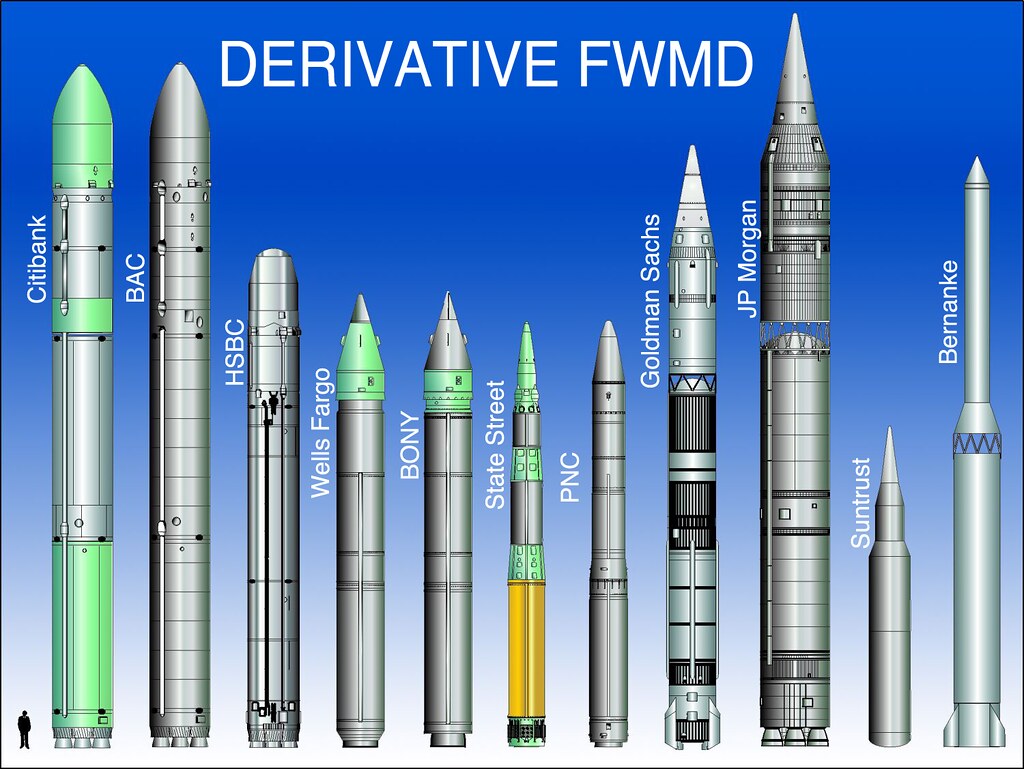
Login or register to post comments
Sat, 09/24/2011 - 08:33 |
Tao 4 the Show 
Banzai, this is hilarious. Just need to show the megatons of destructive power.
Login or register to post comments
Sat, 09/24/2011 - 09:22 |
AssFire 
Seems Bernanke's has multiple warheads..highly destructive.
Login or register to post comments
Sat, 09/24/2011 - 09:52 |
fishface 
Who is that little suicide bomber on the left ?
Login or register to post comments
Sat, 09/24/2011 - 10:18 |
RSloane I believe that is Little Timmy Geithner.
Login or register to post comments
Sat, 09/24/2011 - 11:49 |
Sambo LOL!
Who is he going to blow up? All those 65+ yr old retirees? (Buffet hasn't retired yet)
Login or register to post comments
Sat, 09/24/2011 - 07:17 |
Tao 4 the Show If these banks run 30x leverage, they should have some $8T in real assets backing the $250T in derivatives.
I bet that backing is also largely an apparition. The whole mess is financial numerology to justify the only real money in the equation: that's the part the management pulls out for themselves in salaries, bonuses, etc.
If humans survive (in some state of sanity) for a few decades, schoolchildren will gasp as they learn about the John Law's of our day and the stupidity of the masses who were taken in by the scam.
Login or register to post comments
Sat, 09/24/2011 - 07:33 |
Crash N. Burn In case anyone needs a "John Law" refresh:
http://worldwideponzicollapse.blogspot.com/2011/09/silver-sale-continues...
Login or register to post comments
Sat, 09/24/2011 - 10:19 |
RSloane I did. Thanks for posting that.
Login or register to post comments
Sat, 09/24/2011 - 12:21 |
Crash N. Burn You are very welcome
Login or register to post comments
Sat, 09/24/2011 - 08:00 |
o2sd If these banks run 30x leverage, they should have some $8T in real assets backing the $250T in derivatives.
Not exactly. Economic capital requirements for loans is based on leverage however, for derivatives economic capital is calculated as a multiple of Value At Risk. It would be interesting to know what VaR these 4 banks are reporting.
Login or register to post comments
Sat, 09/24/2011 - 08:49 |
Tao 4 the Show Thanks for pointing that out.
Let's see, since the net value of all assets in the U.S. Is probably only around half of that $250T derivative valuation, we should not have more than $125T at risk. How can we risk more than we have?
Oops, forgot. We can mortgage the future!
Hmmm, maybe that's why we have taxpayer bailouts based on future obligations.
Yo Bernanke - man the long bonds.
(On a more serious note, the 30-40x leverage is bad enough. Using VaR just creates more vaporware by making the actual multiplier bigger. What isn't at risk in the fantasyland they call banking?)
Login or register to post comments
Sat, 09/24/2011 - 09:29 |
Tao 4 the Show For those interested:
"VaR calculates the worst expected loss over a given horizon at a given confidence level under normal market conditions."
Alternate definition by Barry Schacter:
"a number invented by purveyors of panaceas for pecuniary peril intended to mislead senior management and regulators into false confidence that market risk is adequately understood and controlled."
Formerly sane humans should at this point bifurcate into those weeping uncontrollably in their soup and others laughing maniacally while shaking their fists at the gods.
That $250T is built on 30-40x a base and that base is essentially fabricated from nothing. It's all complete madness - just air. And the wizards of finance magically extract billions in salaries and bonuses from that air. Or so it would seem. In truth, they extract it from those who work for a living, and increasingly, from those not yet even born.
Login or register to post comments
Sat, 09/24/2011 - 14:18 |
Kayman Tao 4 the Show
VaR
"a number invented by purveyors of panaceas for pecuniary peril intended to mislead senior management and regulators into false confidence that market risk is adequately understood and controlled."
Formerly sane humans should at this point bifurcate into those weeping uncontrollably in their soup and others laughing maniacally while shaking their fists at the gods.
That $250T is built on 30-40x a base and that base is essentially fabricated from nothing. It's all complete madness - just air. And the wizards of finance magically extract billions in salaries and bonuses from that air. Or so it would seem. In truth, they extract it from those who work for a living, and increasingly, from those not yet even born.
Beautiful, Succint, worth repeating. Thank you.
Login or register to post comments
Sat, 09/24/2011 - 10:21 |
disabledvet "we the people" had no choice in this. this was "choiced" upon us. i sense ferment among the natives. i recommend wads of cash...just in case.
Login or register to post comments
Sat, 09/24/2011 - 07:33 |
PaperWillBurn $333 Trillion - The derivative exposure of 25 banks
$6 Trillion - The value of all gold ever mined in the last 5000 years
any questions?
Login or register to post comments
Sat, 09/24/2011 - 09:10 |
LeonardoFibonacci 
Yes. How do i get some gold?
Login or register to post comments
Sat, 09/24/2011 - 10:25 |
disabledvet that's easy Leonardo. "i am a banker and i have much gold. i will sell you some provided you don't mind me lending you money." Of course "you realize your government has already agreed to this deal."
Login or register to post comments
Sat, 09/24/2011 - 11:46 |
Mr Lennon Hendrix You could try panning. It is a nice workout too.
Login or register to post comments
Sat, 09/24/2011 - 07:34 |
BennyBoy 
If its insurance, where are the regulators?
If its gambling, where are the regulators?
These "banks" aren't too big to fail.
They are too big to succeed.
Login or register to post comments
Sat, 09/24/2011 - 07:40 |
HD 
Wait. Just wait. 250 TRILLION? TRILLION...with a "T"? 2010 World GDP was approximately 63 Trillion.
HOW THE HELL DO YOU UNWIND 250 TRILLION?
Login or register to post comments
Sat, 09/24/2011 - 07:49 |
Motley Fool 'Gradually... then suddenly'
;)
Login or register to post comments
Sat, 09/24/2011 - 08:20 |
Withdrawn Sanction 
+1.618
Login or register to post comments
Sat, 09/24/2011 - 08:24 |
Sri Two words: Bernanke and FED
Login or register to post comments
Sat, 09/24/2011 - 11:52 |
Mr Lennon Hendrix Three words: Bernanke, the FED....lose.
Login or register to post comments
Sat, 09/24/2011 - 09:15 |
PAUL LEO FASO 
The answer on how to unwind $250 Trillion lies here with the ultimate solution;
http://www.zerohedge.com/print/365866
Login or register to post comments
Sat, 09/24/2011 - 14:10 |
Hulk "HOW THE HELL DO YOU UNWIND 250 TRILLION? "
By taking out a second you silly!
Login or register to post comments
Sat, 09/24/2011 - 08:03 |
Smithovsky Regulators: "$250 trillion? There's no way anything can go wrong there. Back to sleep, boys, we got government jobs so that we would have high pay and job security, not to actually do something useful."
Login or register to post comments
Sat, 09/24/2011 - 07:49 |
AssFire The Bible teaches, "The rich ruleth over the poor, and the borrower is the servant to the lender" (Proverbs 13:22).
The Bible also teaches, "The wicked borroweth and payeth not again" (Psalms 37:21a).
So, I think these fuckers must have felt as they had seen it and dealt with it all before...but 250 trillion?? lmao
Login or register to post comments
Sat, 09/24/2011 - 07:53 |
HD Something wicked this way comes...
Login or register to post comments
Sat, 09/24/2011 - 08:22 |
Withdrawn Sanction "Wicked" is just not a word that comes up in everyday conversation. But how appropriate in this context. Wicked, man. Wicked.
Login or register to post comments
Sat, 09/24/2011 - 08:36 |
Pseudo Anonym The Bible teaches..
using somebody else's ideas, are we? Giveth credits when you cut & pasteth.
http://lewrockwell.com/north/north1039.html
Login or register to post comments
Sat, 09/24/2011 - 09:41 |
AssFire Nice article.. uh, I cited the fuckin bible?
Login or register to post comments
Sat, 09/24/2011 - 07:44 |
Robslob 
Yes, just spit balli here but would that make my gold worth $50,000 + per ounce?
Login or register to post comments
Sat, 09/24/2011 - 07:52 |
Smithovsky Jokes aside, is the main reason no one is too eager to start regulating derivatives because the banks wouldn't have anywhere close to the needed collateral and would have to unwind these positions leading to financial armageddon?
Login or register to post comments
Sat, 09/24/2011 - 07:54 |
Motley Fool Yup. So they keep ignoring the problem hoping it will go away. Instead it grows, until one day soon...
Login or register to post comments
Sat, 09/24/2011 - 11:06 |
X.inf.capt HELLO, MOTLEY,
when i wtote that comment in 'disapointment with the fed' about people dumping phyiscal at $39. you were one of the few who didnt run me through a woodchipper.
THANK YOU.
what a difference 72 hrs makes,,,
i guess we both know wnat was going on now. i think those people had more than an 'educated guess'. ya' think.
oh well, such is life in the ZH gladiator school for a newbie....
see ya around, bro.
Login or register to post comments
Sat, 09/24/2011 - 11:55 |
Motley Fool :P
Login or register to post comments
Sat, 09/24/2011 - 08:04 |
AssFire Nonetheless those fees and markups on imaginary money was great while it lasted.
I get that same power kick when I'm the bank in a good Monopoly game.. I play where the market prices on the board mean nothing, IOU's are permitted and encouraged (if I handle the paper) and instead of "go to jail" you just get an additional $2,000,000 (same for passing Go). Unfortunately the games end when the exponets get too great for my calculator...
Login or register to post comments
Sat, 09/24/2011 - 08:24 |
Withdrawn Sanction "no one is too eager to start regulating derivatives because the banks wouldn't have anywhere close to the needed collateral..."
I suspect you are right. If so, then even on a net basis, these guys are in hot water....and I think they know it.
Login or register to post comments
Sat, 09/24/2011 - 14:30 |
Kayman Withdrawn Sanction
The evidence is hidden in plain sight. Bonuses are paid today from liquidity- so long as Bernanke keeps the cash flowing to these boys, they will continue to spray perfume over their shit.
Login or register to post comments
Sat, 09/24/2011 - 08:25 |
AssFire I moved the company accounts to Chase...Was supposed to be 100% insured if non-interest bearing. I guess so many people did the same because now there is talk of service charges coming because the banks are paying so much insurance on all the cash parked in these accounts.
Anyone else heard the same?
Login or register to post comments
Sat, 09/24/2011 - 08:57 |
snowball777 HAhahahaha....dumbfuck.
Login or register to post comments
Sat, 09/24/2011 - 09:55 |
AssFire http://seekingalpha.com/article/290525-get-ready-for-negative-interest-r... I've heard it mentioned elsewhere...
You might not understand.. this is the working capital for my company and it is hard to feel safe just putting it anywhere. It had to be spread over several banks before the limit was lifted.
or
You might be a dick
Knowing you are a product of Berkeley, I'll go with the latter.
Login or register to post comments
Sat, 09/24/2011 - 14:10 |
snowball777 a) I didn't go to Berkeley (just a bear who likes gold)
b) You must have some DCF if you're so desperate you'd stash your capital with known felons
c) You calling me a dick is some serious pot kettle action with your long history of abusive trolling here
Eat a bowl of dick and pay the piper, assfucked.
Login or register to post comments
Sat, 09/24/2011 - 14:36 |
Kayman Negative interest rates have been around a long time- its called banking fees. Smart move, though, to split up your working capital. I don't trust any of these slimy banking sons-of-bitches.
Login or register to post comments
Sat, 09/24/2011 - 08:00 |
WiZlon So, how long is it before Tyler gets hired as a consultant by the top-four (or more) big banks. His job will be...to stop researching and especially to stop publicly-reporting on the banks. Great work again ZH!
Login or register to post comments
Sat, 09/24/2011 - 08:59 |
fingulas 
I hear he can do this job from home.
Login or register to post comments
Sat, 09/24/2011 - 14:42 |
Kayman Warren wants Tyler to replace Becky Quick, but TD is negotiating $5 billion of common, the preferreds are locked up./sarc/ (for you ultra-sensitive types)
Tyler's stock-in-trade is honesty, raw, often brutal. If Tyler sells out, all is lost.
Login or register to post comments
Sat, 09/24/2011 - 08:01 |
Belarus Kind of makes physical look attractive no matter what spot prices they reach. It's hard not to think of the all the folks advice who nailed it in the financial crisis that have not wavered, Burry, Taleb, etc: own physical, hard assets. It kind of makes me rethink my deflation on ideas on the moment patch. inflation/deflation: won't matter.
Login or register to post comments
Sat, 09/24/2011 - 08:04 |
Pseudo Anonym interesting, rob kirby has been reporting on this issue well over 2 years that I am aware of. Here's one example:
http://www.marketoracle.co.uk/Article12522.html
Login or register to post comments
Sat, 09/24/2011 - 11:14 |
Tyler Durden 
So has Zero Hedge. Here is one example
http://zerohedge.blogspot.com/2009/03/occ-issues-update-on-bank-trading-and.html
Login or register to post comments
Sat, 09/24/2011 - 14:44 |
Kayman Tyler Durden
Some of the newbies ought to read the archives.
Login or register to post comments
Sat, 09/24/2011 - 14:59 |
Hulk Its a full time job just reading and digesting the new shit...
Login or register to post comments
Sat, 09/24/2011 - 15:38 |
Kayman Hulk
Too true...
Login or register to post comments
Sat, 09/24/2011 - 08:08 |
Sequitur Banks should be like utilities. Lend some money, earn a reasonable return. High capital requirements, and lots of insurance (FIDC, SIPC) to cover any bank that goes bust.
And to think that in may ways, USA has a better system than many foreign countries. Yes we have deep flaws, but at least we have some form of regulations, SEC filings, and audits. Yes the banks lie and their numbers are gamed, but, it's still better than what you will find almost anywhere else. I believe this is a key reason people still see USA as safe haven: regulations and courts, which are still the envy of many countries. Good luck trying to enforce a contract or recover from a fraud in China if you are up against a Chinese citizen, I've firsthand experience how foreign business gets hometowned like you wouldn't believe in China.
If only our stupid politicians and regulators understood that vigorous enforcement and cleaning out fraud = healthier economy, albeit at the expense of banker bonuses, which is the only thing that seems to matter.
Login or register to post comments
Sat, 09/24/2011 - 08:09 |
conork So if it all implodes, which is better physical precious metals or having cash?
Im exposed 50/50 at the min
Login or register to post comments
Sat, 09/24/2011 - 11:10 |
centerline 
Anyone who says they know for sure is full of shit. The ride from where we are today to whatever is in store for us tomorrow is going to be bumpy. That is about the only thing we can say for sure. The rest boils down to probabilities, staying nimble, staying on step ahead of the crowd, etc.
Hedged both ways seems like a smart place to be right now. That could change tomorrow of course.
Login or register to post comments
Sat, 09/24/2011 - 08:10 |
Sri Now, apparently those in the know no longer even want on of those top five as swaps counterparty.
BTW, look at the top five orignators of mortgages in the United States (who now control 60% of all mortgage originations).
And how long did it take for the MS and GS to become FDIC insured institutions anyway? Two days?
It's that damned Dodd Frank legislation and those loans to those damn minorities that are causing all the problems.
Login or register to post comments
Sat, 09/24/2011 - 14:47 |
Kayman "It's that damned Dodd Frank legislation and those loans to those damn minorities that are causing all the problems."
Are you giving the Fed and its owners a pass ????
Login or register to post comments
Sat, 09/24/2011 - 08:12 |
Withdrawn Sanction These guys look like they keep doubling down on bad bets knowing that eventually one of the bets has to pay off. And in theory, this is true. However, at some point, the doubling and redoubling of the bets gets so large that no one can pay them off (even on a netted basis).
Then add to that TD's analysis that a non-linear event in one counterparty bank wrecks the whole system and you've got a house of cards just waiting for the slightest puff of a breeze. No amount of QE will be able to stop this inverted pyramid from imploding once it starts this time. It's just too big relative to the abilities of counterparties (or their government surrogates) to pay.
PS Thanks for the data and analysis TD. Good work. WS appreciates your efforts.
Login or register to post comments
Sat, 09/24/2011 - 08:14 |
Belarus Once last thought for the night: GoldMoney and Sprottmoney is saying demand is surreal for physical right now which is contrarty to what any conventional wisdom would ever tell you in a quadrillion year lifetime. And, here we have, you know, Bank of America completely on the brink (jsut see ZH post). And here we have this mad dash out of paper and into physical with spot prices falling off a cliff?
Okay, let me guess who the buyers might be: BAC, JPM, GOLDMAN, CITI, et al executive and board members as they dump all paper through businesses while the cocksuckers are loading up. There are no words to describe these cocksuckers.
Login or register to post comments
Sat, 09/24/2011 - 08:26 |
Withdrawn Sanction Lower prices induce an increase in the quantity demanded.
Login or register to post comments
Sat, 09/24/2011 - 08:26 |
o2sd At this point the economist PhD readers will scream:
Interesting. I had long been under the assumption that one or more of the Tylers were Quants (front office), which are usually Math PhDs rather than economics. Still ...
Of particular note is that while virtually every single bank has a preponderance of its derivative exposure in the form of plain vanilla IR swaps (on average accounting for more than 80% of total
Which, when written, are NETT ZERO.
Morgan Stanley, ... has almost exclusively all of its exposure tied in with the far riskier FX contracts, or 98.3% of the total $1.793 trillion.
Which begs the questions:
1) Which currencies?
2) What moneyness?
3) What maturity profile?
3) Are they actually XCCY IR swaps that they report as FX?
4) Are they nett long or short the USD?
Login or register to post comments
Sat, 09/24/2011 - 09:08 |
Sri XCCY IR Swaps require exchange of principal at maturity (and perhaps more frequently) so the risk is far greater than vanila IRS
Login or register to post comments
Sat, 09/24/2011 - 10:12 |
o2sd I thought only XCCY swaps swapped the principle.
XCCY IR uses a notional, no?
Login or register to post comments
Sat, 09/24/2011 - 10:44 |
Sri Maybe we are mixing terms. To me an XCCY IR swap each side has a different currency (USD on side 1, GBP on side 2). They rate can be fixed/fixed, fixed/float (pay 3% USD receive GBP 3M LIBOR), float/float(saw this a lot with USD/JPY)
XCCY IR Swaps usually exchanged the principal at initiation and maturity -- there were big red buttons on the IR swap entry screens that said principal exchange (usually at initiation an matuirty).
There were also these 'market value swaps' or some such thing that were more like total return swaps and the currency gain/loss was exchaned periodically (either in cash or the notional balance was increased).
Login or register to post comments
Sat, 09/24/2011 - 19:11 |
o2sd There are two types of cross currency swaps. There are cross currency swaps and cross currency interest rate swaps. In THEORY, because of Interest Rate Parity, there should be no difference in those two swaps, but in practice, there is.
Cross Currency Swaps do exchange a principle, but XCCY IR swaps (I believe) do not (coupon based on notional). I could be wrong though, it's happened before.
It just doesn't seem possible that MS has 1.7T in real FX exposure with so little economic capital, hence my speculation that their FX outstanding is largely notional, tied up in XCCY IR swaps.
If that is not the case, then they truly are fucked.
Login or register to post comments
Sat, 09/24/2011 - 08:27 |
arkel 
"the biggest banks are not only getting bigger, but their risk exposure is now at a new all time high and up $5.3 trillion from Q1 as they have to risk ever more in the derivatives market to generate that incremental penny of return."
Given that the bulk of the derivatives are interest rate swaps, doesn't Operation Twist lower the spreads causing them to get EVEN bigger to make a profit?
Login or register to post comments
Sat, 09/24/2011 - 08:34 |
lolmao500 Yes. Because of Operation Twist, the banks are gonna up the ante even more.
Now it's 250 trillion, but by June 2012, it'll be way way higher than that. If they did $5.3 trillion in Q1... you betcha they can do, in Q4-Q1-Q2, in 3 quarters.... X5.3 trillion + operation twist factor ... they can add to that at least 20-30 trillion, EASY.
They basically gonna add, in 9 months, half of the world GDP in derivatives to the system.
Little Ben just assured that the collapse would be even bigger when it goes down.
Login or register to post comments
Sat, 09/24/2011 - 10:29 |
RSloane I don't believe 'the system' will still be up and running in 9 months time but that maybe giving it a wider view than it deserves. To your last point, the collapse is going to be well and truly financial armageddon. Jim Rogers is right, buy a farm and learn how to work it.
Login or register to post comments
Sat, 09/24/2011 - 08:28 |
J_man Well what are we doing about it lads?
Login or register to post comments
Sat, 09/24/2011 - 08:30 |
lolmao500 Ban CDS, problem solved.
Login or register to post comments
Sat, 09/24/2011 - 08:35 |
spanish inquisition 
I had posted a few times that one of the things the Fed needed to do was keep the Big 3 (Euro, $,Yen) rangebound to help with liquidity flows around the world. Never even thought about Fx derivatives...... I shall sign this as The Blind Pig
Questions based on the latest meeting where the Bernanke disappointed and the gold margin increase.
What levels the Fx derivatives are set at and compare against Fed, market rumor action and the Swissy peg?
How much of MS money is being moved to work Fx markets against their clients, or are they being helped by the "idiotic" Fx GS calls? I think the ones at the top realize at this point "you go, I go".
Login or register to post comments
Sat, 09/24/2011 - 08:33 |
Zola 
Quick question, based on the wisdom of ZH , which prime broker do you think will survive the crisis ? Any in the US/EU ? Or is it only in Asia ... ?
Login or register to post comments
Sat, 09/24/2011 - 08:42 |
ZeroPower 
There's a reason why the IRS market is the largest by notional $ derivative outstanding.
As long as basis risk is managed (counterparty risk need not be mentioned..) there is nothing that can happen to those $200tr of exposure.
IRS basically allow a party to enter into synthetic fixed/floating rate financing for firms that need it - and many many do. Yet of course, none of the above posters actually knows squat about swaps and yet the comments come, ridiculing the size of the market. Too funny.
If one wants to ridicule IRS for anything, you can look at their inbred cousins - off market swaps, deferred swaps, circus swaps. Bit more risk involved there, but again, most of the risk is tied into being in the contract with an unworthy counterparty, not to mention not understanding what the fuck kinda of contract one has entered into. OTC IRS clearing will remove the former risk. There is no cure for stupidity however.
Login or register to post comments
Sat, 09/24/2011 - 09:31 |
Sri So I'm paying 6% fixed for thirty years -- I have nothing to worry about?
How does OTC clearing remove any risk? How much capital does LCH have?
Login or register to post comments
Sat, 09/24/2011 - 11:17 |
jm I think his point is that IRS are not exclusively a bank issue. They hedge interest rate risk for businesses, alleviates funding pressure and liquidations and readers don't realize this.
Regarding clearing, I can't think of anything more bullet-proof than SwapClear and payers of a 6% 30y can offset that with an <insert number>y30y.
Login or register to post comments
Sat, 09/24/2011 - 11:21 |
Sri That is the sad part, SwapClear is considered bullet proof. SwapClear is bullet proof because the top ten members can go to the FED, Bank of England, Bank of Canada, Bank of Japan, ECB, RB of Australia (maybe all of them) and borrow at a negative rate with bogus collateral.
And GS and MS were not banks until 2008. They became banks to avail themselves to be able to feed at the pubic trough. And keep SwapClear safe.
Login or register to post comments
Sat, 09/24/2011 - 11:30 |
jm Point well taken.
Login or register to post comments
Sat, 09/24/2011 - 10:25 |
o2sd none of the above posters actually knows squat about swaps and yet the comments come, ridiculing the size of the market. Too funny.
Amen.
Even counterparty risk is small, given that the principal is notional, and the coupon is the delta of the fixed/floating rate.
Yeah, it might be nasty to lose a coupon (in the case of a default), and there might be some cascading/ripple effect in credit markets, but not really a show stopper.
Given the historically glacial pace of Central Bank changes to overnight cash rates, managing basis risk should be fairly trivial matter. The problem recently is the huge volatility in the yield curve due to Fed meddling and Government muddling, which makes basis risk a little harder to manage, but from memory, the maturity profile of the bulk of IRS is <10Y
Good to see you back ZP.
Login or register to post comments
Sat, 09/24/2011 - 10:56 |
Sri Let met get this straight, in 2001, my counterparty agreed to pay me fixed at 6.01% on $100 million for the next thirty years. He decides that he's tired of paying and walks away from the deal. My loss is not worth mentioning?
Granted, if I had collected margin over time, I'd be reasonably okay.
Login or register to post comments
Sat, 09/24/2011 - 19:18 |
o2sd Let met get this straight, in 2001, my counterparty agreed to pay me fixed at 6.01% on $100 million for the next thirty years. He decides that he's tired of paying and walks away from the deal. My loss is not worth mentioning?
First, 6.01% on $100mio with a 3M coupon period is coupon of around 1.5 million. Remember, you only get to default once, so if the counterparty misses a coupon payment, you are 1.5 million in the hole, bonus mangling, but not armageddon.
Second, you are swapping that 6.01 against some agreed floating rate. Current LIBOR 30Y is 4.29%, so the coupon is simply the difference i.e. 2.7%, which means a 3M coupon is roughly 675,000.
Last, if you really don't want to lose that 675k, you could always buy a CDS on the counterparty :)
edit: sorry, my calculations above are wrong, the coupon is actually much smaller than that, but I cbf working it out. Suffice it to say, the risk is small.
Login or register to post comments
Sat, 09/24/2011 - 10:33 |
disabledvet this is...a government. "is repayment part of the contract?"
Lehman Brothers: "hell, no bitch! we're SWAPPING!"
John Paulson: "so would you trade this worthless piece of shit paper for a billion dollars then?"
Wall Street: "Hell yeah mother-fucker. Have all the billions you want!"
Login or register to post comments
Sat, 09/24/2011 - 10:45 |
hack3434 
.
Login or register to post comments
Sat, 09/24/2011 - 10:57 |
hack3434 As long as basis risk is managed
Basis risk is ALWAYS "managed" one way or another and yet, the financial wizzardz always manage to fuck it up as complexity grows. $200tr is a ridiculous number regardless of being notional and "risk" free.
Login or register to post comments
Sat, 09/24/2011 - 15:09 |
Absalon yet the comments come, ridiculing the size of the market.
So there is over $300 trillion in interest rate swaps. Not every borrower or lender will want to swap interest rates. There is not enough debt in the world to justify the size of the swap market.
Login or register to post comments
Sat, 09/24/2011 - 15:15 |
Kayman ZeroPower most of the risk is tied into being in the contract with an unworthy counterparty
And, of course, you will provide ZH a list of "worthy" counterparties.
Too smart by half, n'est pas ?
Login or register to post comments
Sat, 09/24/2011 - 08:45 |
eddiebe 
Ironically and sadly it is the poorest of the poor who are grubbing for every dollar trying to stay above water or even alive that are carrying this monster on their back. Wicked is a milk toast word to describe the monsters that are perpetrating this faux banking scheme. The derivatives monster makes the biblical tower of Babel look like an ant heap. In terms of the I Ching: The ridge post sags to the breaking point.
Login or register to post comments
Sat, 09/24/2011 - 08:52 |
overmedicatedun... 
as long as King FRN is here it can go on..seems China Russia and the Oil states can't get a handle on how to bring it down.
Mr Q in libya took a shot at gold back african money and we see what happened there..not one MSM outlet even guestioned that coup..the biggest news never sees print these days.
PM's whipped ties into this nicely..for a while PM's looked to be an out on the FRN...they must kill PM's for the threat they are to the whole game..invest accordingly until there is a real chance the debt risk heats back up thru defaults of EU members.
So to the point: TBTF banks have unlimited FRN's via the FED
why not keep doing what brings the bonus money in??
If Ron Paul got elected well then we might get a new game but by the way the MSM avoids him..he has little chance..and if he did win hope he stays out of Dallas Tx.
Login or register to post comments
Sat, 09/24/2011 - 08:56 |
Kina 
Ron Paul would be executed by the banks the moment he talks about Fed audit, gold audit, gold standard, tighter banking controls, issuing silver notes.....anything that threatens their position.
They did it before they will do it again. Paul should invest in full body armor. Forget terrists...the banks are the global mafia extrordinaire.
Login or register to post comments
Sat, 09/24/2011 - 08:53 |
Delmar 
Morgan Stanley is fine:
http://www.foxbusiness.com/markets/2011/09/23/morgan-stanley-bounces-aft...
See, nothing is f%^&ed, you're being very undude.
Login or register to post comments
Sat, 09/24/2011 - 10:17 |
Dapper Dan 
Thanks for the heads up Del,
from the fox article.
He confirmed that the firm was in the market buying its own debt to show skittish investors that it had enough cash and liquidity to survive not just the European banking crisis, but the rumors of its own pending demise, which began with a blog posting.
From a 1929 crash article.
Thursday October 25, 1929 the markets crashed, on Friday several of the nation’s largest bankers met to decide what they could do about the situation. Among the attendees were the heads of Morgan Bank, Chase National Bank, and National City Bank. The bankers ultimately decided to purchase a number of U.S. Steel shares above market price. A similar tactic worked to end a previous stock market scare in 1907 when the New York Stock Exchange plummeted, causing many banks and businesses to file bankruptcy. American banker J.P. Morgan and a few other bankers bailed out the banking system using their own money. The bankers who tried to thwart the 1929 stock market crash were unsuccessful. There were positive results, but they were short lived.
Short lived!
Login or register to post comments
Sat, 09/24/2011 - 17:26 |
spankthebernank When I watch shit like this it makes me so happy I tossed my tv out the window 5 years ago. Watching Gasparino and that piece of ass just makes me sick. Cheerleading ass clowns.
Login or register to post comments
Sat, 09/24/2011 - 08:55 |
fdisk 
"Economic Collapse, Financial Manipulation and the Dollar Crisis"
http://www.globalresearch.ca/index.php?context=va&aid=26756
Good article.
Login or register to post comments
Sat, 09/24/2011 - 08:56 |
blindman 
...
.
.
http://english.aljazeera.net/programmes/meltdown/2011/09/201191410551861...
.
The men who crashed the world
The first of a four-part investigation into a world of greed and recklessness that led to financial collapse.
Meltdown Last Modified: 21 Sep 2011 09:26
Login or register to post comments
Sat, 09/24/2011 - 08:59 |
Atomizer 
It all boils down to this... This is why the EU has failed. US needs to reverse course or it too will become the EU.
Free Shit
The folks who are getting the free shit, don't like the folks who are paying for the free shit, because the folks who are paying for the free shit, can no longer afford to pay for both the free shit and their own shit,
And, the folks who are paying for the free shit, want the free shit to stop. and the the folks who are getting the free shit, want even more free shit on top of the free shit they are already getting!
Now... The people who are forcing the people who pay for the free shit, have told the people who are RECEIVING the free shit, that the people who are PAYING for the free shit, are being mean, prejudiced, and racist.
So... the people who are GETTING the free shit have been convinced they need to hate the people who are paying for the free shit by the people who are forcing some people to pay for their free shit, and giving them the free shit in the first place.
We have let the free shit giving go on for so long that there are now more people getting free shit than paying for the free shit.
Now understand this. All great democracies have committed financial suicide somewhere between 200 and 250 years after being founded. The reason? The voters figured out they could vote themselves money from the treasury by electing people who promised to give them money from the treasury in exchange for electing them.
The United States officially became a Republic in 1776, 235 years ago. The number of people now getting free shit outnumbers the people paying for the free shit. We have one chance to change that in 2012. Failure to change that spells the end of the United States as we know it.
A Nation of Sheep Breeds a Government of Wolves!
Login or register to post comments
Sat, 09/24/2011 - 09:33 |
Oh regional Indian Atomizer, the America as you think you understand it, never even took off...
http://www.edrivera.com/?page_id=2
ORI
Login or register to post comments
Sat, 09/24/2011 - 16:46 |
Dan Watie 
it took off but was hijacked to Lower Manhattan.
55 Water St
Login or register to post comments
Sat, 09/24/2011 - 09:13 |
boooyaaaah From Overstock.com DTCC Announcement on Sep. 13, 2011 DTCC Announces Initiative To Revamp Processing of Continuous Net Settlement Obligations New York, September 13, 2011 – The Depository Trust & Clearing Corporation (DTCC) has proposed changing the way its clearing agency subsidiaries, The Depository Trust Company (DTC) and National Securities Clearing Corporation (NSCC), process Continuous Net Settlement (CNS) transactions. The enhanced process would align CNS processing into the risk management control structure used by DTC to reduce risk and boost liquidity efficiencies in the settlement of almost $870 billion in equities that trade in the U.S. markets each day. The proposal is presented in a white paper – CNS Settlement as Delivery Versus Payment in DTC (CNS for Value) – issued to the industry today. In the paper, DTCC asks for feedback on the initiative. NSCC and DTC together clear and settle virtually all broker-to-broker equity, corporate and municipal debt securities transactions in the U.S. In addition, NSCC serves as the equity markets’ central counterparty and guarantees trades by becoming the buyer for every seller and the seller for every buyer for CNS-eligible securities. Under the methodology currently used for CNS obligations, the securities are moved via a book-entry transfer that is free of payment at DTC with the related money settlement occurring at NSCC. With the initiative, called CNS for Value, DTC will process both aspects of the CNS settlement obligation, moving security positions and credits/debits simultaneously through DTC’s settlement system, leveraging DTC’s existing risk management controls (net debit cap and collateral monitor). CNS for Value offers several important benefits to members. It will: • Give them a single, transparent intraday settlement process that allows them to better monitor settlement activity and manage liquidity needs, • Continuously net members’ CNS credits and debits with DTC credits and debits which may reduce a member’s intraday funding requirements, and
• Position DTCC to support more robust intraday settlement finality and liquidity management by supporting a multi-cycle settlement process. "With the implementation of CNS for Value, we will be able to mitigate systemic risk and promote harmonization of the U.S. settlement system with evolving international standards for financial market infrastructures," said Susan Cosgrove, DTCC managing director and general manager, Settlement and Asset Services. "This change will give DTC, NSCC and their members more robust and transparent methodologies for managing intraday settlement liquidity risk." CNS transactions processed as DVP at DTC will be subject to DTC’s collateral monitor and net debit cap risk management controls. The net debit cap control limits the net debit balances of DTC participants so that DTC will have sufficient liquidity to fund end-of-day net settlement with sufficient collateral support based on the collateral monitor. The use of DTC’s collateral monitor and net debit cap controls on CNS transactions will protect DTC from potential spillover risks from NSCC. "The concept of moving DTC from a single end-of-day settlement model to a more robust intraday multi-cycle settlement model is also being explored," said Julie Krill, vice president, Settlement and Asset Services. "This multi-cycle model would further mitigate certain risks by providing members and the market with intraday settlement finality." DTCC anticipates implementation of CNS for Value in early 2014. Details of the CNS Settlement as Delivery Versus Payment in DTC (CNS for Value) initiative and the multi-cycle settlement proposal can be accessed at www.dtcc.com under Thought Leadership, White Papers. http://www.dtcc.com/news/press/releases/2011/press_release_dtcc_announces_initiative.php
Login or register to post comments
Sat, 09/24/2011 - 09:24 |
Atomizer Ctrl f + Basel III
http://www.iss-mag.com/sitemap
Edit: Just in case you missed the small ad to the left.
http://finance.flemingeurope.com/basel-forum/
Login or register to post comments
Sat, 09/24/2011 - 09:34 |
chubbar I have no idea what this article means but my hand instinctively covered my wallet when I started reading it.
Login or register to post comments
Sat, 09/24/2011 - 09:31 |
johnnymustardseed 
Who invented derivatives?? Blythe Master, enough said!
Login or register to post comments
Sat, 09/24/2011 - 19:34 |
clagr I cannot tell a lie. I was involved in the development and sale of the first CMO (Collateralized Mortgage Obligation)
Login or register to post comments
Sat, 09/24/2011 - 09:34 |
YHC-FTSE 
This is something I've actually been looking forward to reading. Many thanks to whoever posted and to Reggie.
Saved for (In)digestion later.
Login or register to post comments
Sat, 09/24/2011 - 09:41 |
digalert 
What a pain in the austerriere!
Login or register to post comments
Sat, 09/24/2011 - 09:43 |
celticgold 
Atomizer ...u mean like hope and CHANGE?
Login or register to post comments
Sat, 09/24/2011 - 09:58 |
Caviar Emptor 
But But But.....Plan A for the economy was "Prosperity and Peace Through Financialization!"
That's what all the collective brains promised in the 1980s in response to the plan of De-Industrialization that followed Nixon's China accords. They were supposed to make stuff, we were supposed to buy it on credit. That was supposed to be the deal!! We would all become capitalists to the world: doing the developing world's lending and banking, counting all the beans in CHina and the rest of the developing world!
What a vision! What a world it was suposed to be that was promised to us!
Of course it all rested on accords that only the biggest governments could ever make let alone enforce. China would only make such a deal on the full faith and credit of the US gov for a start. And ironically it was the high priests of small government who pushed the plan, preaching small government while at the same time making the grandest of grand plans to change the enitre US economy over to "The Service Economy", "Financialization" and "The Ownership Society" and also implementing large transfers of wealth using "Trickle Down Theory".
So of course it's only the next logical step to nationalize the TBTF banks that are already running under a hybrid nationalized model now with both implicit and explicit bailout guarantees. Europe will be the guinea pig. When that pig can fly, the US only needs to take the next step and copy. And we might finally be able to go back to our iPads and browse porn and eye candy in peace from anywhere on the planet!
Login or register to post comments
Sat, 09/24/2011 - 10:02 |
PulauHantu29 It's all about Bonuses.
80:1 leverage allows each bank to pay out $15 Billion in Bonuses to their execs when the trade is postivie.
If it's a losing leveraged trade, the massive loss is passed over to the Central Bank (aka, taxpayers).
Sweet if you are a Banker.
How about a law requiring these fellow to pony up their personal assets backing their trades?
Login or register to post comments
Sat, 09/24/2011 - 10:03 |
Seasmoke 
CLAWBACKS
a claw thru the skull of all the banksters and take back all assets of the past 10 years
Login or register to post comments
Sat, 09/24/2011 - 10:07 |
Caviar Emptor @Pulau: Or....you could go the other way and work for a banker. As a domestic servant, exotic dancer, pyramid construction worker, 'lady' in waiting or whatever! If you can't beat 'em, spoil 'em!
Login or register to post comments
Sat, 09/24/2011 - 10:02 |
Seasmoke when losing at the track and the day is getting late, the only way to get out is to bet bigger and bigger longshots, that usually doesnt work out to well and go home broke
Login or register to post comments
Sat, 09/24/2011 - 10:13 |
Lee these "derivatives" are satanic. the people who created them worship satan. the fact that they are legal makes our legal system satanic. the fact that lawyers will defend the creators of said satanic devices is proof that all lawyers are evil. Sanhedrin, our judicial system.
But no. don't discuss that.
lets get lost in the satanic labyryth and intellectual madness of the technicals of denial.
Login or register to post comments
Sat, 09/24/2011 - 10:24 |
dwdollar 
I agree. They're meant for one thing and one thing only. A doomsday unwind that's only waiting for Satan's nod. It's just a matter of time.
Login or register to post comments
Sat, 09/24/2011 - 10:19 |
Caviar Emptor The correct buzzword is "Federally Subsidized Gambler".
That's the unofficial but correct job description for today's bulge bracket ibanker. Not a bad gig
Login or register to post comments
Sat, 09/24/2011 - 10:25 |
Lee an oldie but goodie:
"The few who understand the system, will either be so interested from it's profits or so dependent on it's favors, that there will be no opposition from that class."
Mayer Amschel Bauer Rothschild
Login or register to post comments
Sat, 09/24/2011 - 10:35 |
EHM Mayer didn't foresee Zero Hedge.
Login or register to post comments
Sat, 09/24/2011 - 10:26 |
Caviar Emptor You never have to go looking very far to confirm the grand plan: YUM dumps 2 US restaurant chains while accelerating investment to expand in India
http://www.businessweek.com/news/2011-09-22/yum-brands-sells-a-w-long-jo...
Login or register to post comments
Sat, 09/24/2011 - 13:00 |
falak pema 
That's bad news for our Long John Silver at ZH. Does he know about this? He may not want to sell chili beans in India!
Login or register to post comments
Sat, 09/24/2011 - 10:26 |
wannabe traitor and here i am being told robbers and pirates are evil!
Login or register to post comments
Sat, 09/24/2011 - 11:02 |
RSloane How can you think that? That describes our governments throughout the globe. Where is your confidence?
Login or register to post comments
Sat, 09/24/2011 - 10:36 |
blindman who is that man behind the curtain?
.
pay no attention...
http://www.youtube.com/watch?v=YWyCCJ6B2WE
Login or register to post comments
Sat, 09/24/2011 - 10:44 |
Surly Bear 
And Moses said 'Let my people go.'
Login or register to post comments
Sat, 09/24/2011 - 10:44 |
Yes_Questions 
The first step is admitting you have a problem.
Login or register to post comments
Sat, 09/24/2011 - 10:45 |
FLUSA.com 
Bernanke: "Duhh Winning!"
Login or register to post comments
Sat, 09/24/2011 - 10:52 |
monopoly 
Does anyone sleep around here? Getting all riled up early today. These numbers have been known at Zero Hedge for ions now. Just does not matter...till it does. And that day is coming. And also enjoy Reggies posts, but admit a link would be better and a little less of me, me. But he does a great job.
My dealer was so busy late Friday could not get an order in for silver. Hopefully it moves lower on the open. And check out almost every blog advising doomsday for us. It is over, gold moving lower, silver a lost cause for decades. The cockroaches come out in droves once the food spills off the table. Just gives us more opportunity to buy more of what we want.
I am pretty good with numbers but these are so mind boggling I have to think about it again and again. And the brilliant ones want us to sell our gold, silver and miners. Think I will just keep what I got.
Login or register to post comments
Sat, 09/24/2011 - 10:52 |
blindman http://www.thehindu.com/news/international/article2479928.ece?homepage=true
.
NASA’s “errant satellite” plummeting to earth at 27,000 kph
Narayan Lakshman
.
...
"“Components which do survive are most likely to fall into the oceans or other bodies of water or onto sparsely populated regions like the Canadian Tundra, the Australian Outback, or Siberia in the Russian Federation,” NASA explained, adding that during the last 50 years an average of one catalogued piece of debris fell back to Earth each day and “no serious injury or significant property damage caused by re-entering debris has been confirmed.”
Yet obviously no place on earth was entirely safe from the dead satellite’s descent – in a small footnote on its website NASA recommended: “If you find something you think may be a piece of UARS, do not touch it. Contact a local law enforcement official for assistance.” This of course assumes it missed the individual in question.
Keywords: UARS, NASA, Upper Atmosphere Research Satellite
"
Login or register to post comments
Sat, 09/24/2011 - 11:01 |
Michelle When TBTF were bailed out and CDS contracts were honored, this action only reinforced the validity of the derivatives markets which explains why this market has grown since then. At that time, CDS notional was approximately $60T and after all the blowups shrunk to about $28T. Interestingly, global wealth destruction was about $30T. Coincidence? I think not. Now imagine an FX implosion with the failure of the Euro, how much will be sucked out of the markets? What have our puppet leaders learned since then? Only Angela Merkel has banned naked CDS in her country so obviously she has a clue.
As for allowing derivatives to exist to hedge risk, they only create MORE risk. How has credit and capital been extended prior to the creation of derivatives? The old-fashioned way - performing due diligence and and knowing and trusting the borrower. Reputation and character often was the only basis for extending credit as credit history may not have existed, but only a handshake and a promise were required. The derivatives market has made it possible to forgo the basic concept of trusting and knowing your borrower for repayment and instead the notion that all risk can be hedged is a misnomer. The layers and layers of derivatives make for a very unstable system and has only become more unstable as nobody has the first clue how to regulate or unwind them in an orderly fashion. Therein lies the crook of the problem and the only solution is to allow failure to the point where none of these contracts are honored. If the players don't own the actual asset, no payoff, ever. My belief is that the damage would be much smaller as money doesn't change hands and forced-selling would not occur, thus reducing systemic risk. The best way to regulate this market is to make it impotent.
Login or register to post comments
Sat, 09/24/2011 - 11:53 |
disabledvet "provided the government can afford it" since the entire idea of securitization was...just like the internet...an invention that without the government could not possibly exist. What say you? Are we "affording it"?
Login or register to post comments
Sat, 09/24/2011 - 12:01 |
headless blogger Ya, this is really a great overview. Good point about the risk actually being worse when created to reduce risk.
Login or register to post comments
Sat, 09/24/2011 - 11:02 |
centerline Bilateral netting? Give me a break. Modern PhD economists don't "get it" because they cant the see the forest for the trees. That the macro design of the system is a ponzi scheme that concentrates assets and distributes liabilities. A system built on the paradigm of perpetual growth.
Login or register to post comments
Sat, 09/24/2011 - 11:11 |
D.O.D. 
The simple answer is "Yes"...
Login or register to post comments
Sat, 09/24/2011 - 11:17 |
reader2010 
Gold needs to go to the moon to reflect this fact.
Login or register to post comments
Sat, 09/24/2011 - 11:17 |
RobotTrader 
If the Derivatives Casino collapses, then the only thing worth holding will be U.S. Treasuries and U.S. Dollars.
Everything else will get sucked down into the vortex.
Even stocks like WFM, SBUX, ANF, etc.
So it is imperative that the Fed starts printing even faster.
Login or register to post comments
Sat, 09/24/2011 - 11:58 |
disabledvet THAT IS THE ONLY THING WORTH HOLDING RIGHT NOW. We know this for a fact. So i ask you again Mr. Robot: "why are equities rising?" Let us observe:
http://www.youtube.com/watch?v=g53S4zRbo-k&feature=player_detailpage
Let's face it. We're Americans. We love our Robots!
Login or register to post comments
Kayman
Robo - you should stroke it "even faster"
Login or register to post comments
Sat, 09/24/2011 - 11:25 |
Doug Eberhardt Tyler,
Thanks for the article...I have been writing about the nations top 5 banks exposure to sub-investment grade derivative risk for the last year or so. CNBC, etc. won't ever discuss this issue. These derivatives sit at over $4 trillion now, more than at the height of the 2008 financial crisis.
Increase In Bank Sub-investment Grade Derivatives Reveal A Need For Gold Insurance http://buygoldandsilversafely.com/economy/increase-in-bank-sub-investment-grade-derivatives-reveal-a-need-for-gold-insurance/
There will be no real counterparty to these lower grade derivatives except the lender of last resort, the Fed. The Fed's balance sheet is already a mess and it will be a natural conclusion that "faith" in the Fed will be fleeting.
Add to the banking mess the fact they don't mark to market their assets, with the full blessing of the Financial Accounting Standards Board (FASB) and it's plain to see the dire straits they are in. Yet again, CNBC et al never discusses this issue.
Thanks for bringing it up...again... The banking crisis is what will bring this Humpty Dumpty economy to its knees.
Login or register to post comments
Sat, 09/24/2011 - 12:02 |
ivars Oh, and here is the oldest and most miserable one-DJIA and correspondingly, economy forecast made in Feb6, 2011:
http://saposjoint.net/Forum/viewtopic.php?f=14&t=2626&start=0#p30485
Whole 2012 will be a recession in the USA (and many other places)-that was clear long ago.
Login or register to post comments
Sat, 09/24/2011 - 12:18 |
headless blogger I don't know...maybe we are better off investing in a tent and a solar generator. Maybe a pitbull and fishing pole. If you live in an area like I do, hardly any jobs, and its suppose to get worse, maybe its better just to opt out of the system and buy a copy of Walden Pond. I really don't know...
Login or register to post comments
Sat, 09/24/2011 - 12:14 |
headless blogger 250 Trillion!! Oh my shit..
Somebody needs to do something. And people are bitching about some minimum wage dude collecting food stamps? At least the food stamps contribute to the community they are spent in.
What are these derivatives doing for anyone but helping to clean our clocks out? And its growing.
How depressing...
Login or register to post comments
Sat, 09/24/2011 - 15:05 |
Michelle It is depressing, and the players know that liquidity and capital will keep flowing to help defer the inevitable. We ARE the liquidity and the capital, folks. We are coming close to a stalemate, reminds me of the Cold War. Are the players with their WMD going to win or are our governments going to take control and reign in this insanity? Currently the players are ahead in this game as they make up the rules as they go along, and if they don't like something they throw a temper tantrum like a bratty two-year-old and throw a fit. Sadly, there are just too many two-year-olds.
Login or register to post comments
Sat, 09/24/2011 - 12:16 |
Quixote2 
Too big to get my head around. My simplified take, the banks collectively are one big Ponzi scheme. You go in to get money (fiat) and they always have the paper and ink or electrons to provide you with your request and to pay the executive bonuses, with or without the central bank printing.
The fall of the banks will start when someone goes in and asks for cash..... then the bank runs commence.
Login or register to post comments
Sat, 09/24/2011 - 15:52 |
Kayman Banking cash is paid promptly in Bonuses. "You covet what you see, Clarice..."
Wall Streeters have 2 eyes- one looking at the Bonus Pool and one looking at Cash-On-Hand.
Login or register to post comments
Sat, 09/24/2011 - 12:35 |
Ellesmere 
Good article...
Login or register to post comments
Sat, 09/24/2011 - 12:36 |
MFL8240 They can all eat shit and die!
Login or register to post comments
Sat, 09/24/2011 - 12:57 |
falak pema the question that comes to mind is : How does this derivatives exposure face up to the sovereign debt exposure of French/Italian/ Belgian/Dutch/UK/German banks.
The sums involved are so huge in both cases that we have difficulty evaluating the downside potential risk...for the financial community as a whole.
Login or register to post comments
Sat, 09/24/2011 - 15:54 |
Kayman Don't worry Falek. They are all backed by Worthy Counterparties.
Login or register to post comments
Sat, 09/24/2011 - 12:59 |
matrix2012 
WOW, the figures of the derivatives' $$$$$$$$ involved here do thwart the issues of the USA's debt and all the debts from other regions/countries... also making the surplus reserves of many countries even the world's highest insignificantly tiny :D One single company of the TOP FOUR is even "worth" more than any medium to big country. OMG...those companies are soooo RICH!!! TBTBF
It's really amazing to learn the "wealth" of those behemoth companies like JP MORGAN, CITI, BANK OF AMERICA, GOLDMAN SACHS, also the newcomer, the fifth: HSBC
OTOH it also makes the entire Planet Earth seems to have much higher values..... JUST IMAGINE ALL THE FIGURES mentioned ON THE PAPER there!!! And the USA is fully loaded of such high value industry...the most lucrative one: FINANCIAL INDUSTRY!!! LOL! Please forgive and save me, The Almighty!
Login or register to post comments
Sat, 09/24/2011 - 14:13 |
Atomizer Repost..
TPTB to peasants.. We will use all available resources to contain our derivatives nest.
Login or register to post comments
Sat, 09/24/2011 - 13:36 |
Forgiven 
That's the genius of their evil plan...make themselves a weapon of mass destruction. The way to defuse the bomb is simple, unlace all the wiring of the fraudulent paper mills and announce both sides of the fraud are null and void.
Login or register to post comments
Sat, 09/24/2011 - 15:55 |
Kayman And the criminals get to keep their bonuses.
Login or register to post comments
Sat, 09/24/2011 - 14:06 |
Atomizer The whole concept of Global Governance is to fleece the existing system(s). When the host is dead, many geniuses will appear on camera pitching the new system. These peeps will be speaking to you behind 10" bullet proof glass. The solution will be spun as "removing fraud" and limiting freedoms to restore sovereign state entities. It's all a lie.
Enjoy the next chapter of your central planning comic strip. Don't really care if you disbelieve this warning, you've simply been told.
Login or register to post comments
Sat, 09/24/2011 - 15:02 |
you enjoy myself 
The problem with bilateral netting is that it is based on one massively flawed assumption, namely that in an orderly collapse all derivative contracts will be honored by the issuing bank
this is probably the quote/warning of the decade. when you've exposed yourself to such gigantic, unfathomable counterparty risk it makes no difference whether you've supposedly netted it out. the exposure to just one couterparty's contracts likely exceeds 100% of the assets of the buyer -- one default will blow everyone up completely. especially when the issuing bank has sold CDS insurance worth many, many multiples of their own net assets -- what can't be paid out, won't.
Login or register to post comments
Sat, 09/24/2011 - 15:58 |
Kayman But...but...but... aren't they all backed up by Worthy Counterparties ?
Login or register to post comments
Sat, 09/24/2011 - 15:42 |
theprofromdover 
The dirty rotten scoundrels are going to make Au & Ag radioactive. They'll find a way.
They need to take it out, they can have no safe havens for anything outside the system, otherwise the game is up.
How dare they. The very definition of evil.
Login or register to post comments
Sat, 09/24/2011 - 15:46 |
HROLLER 
WAMU Truth http://www.youtube.com/watch?v=pd_zI1FNIJ0
Login or register to post comments
Sat, 09/24/2011 - 15:48 |
robertocarlos Canadian banks are safe. Thank G-d.
Login or register to post comments
Sat, 09/24/2011 - 16:01 |
Kayman The 4 Greatest Lies:
1. I luv you
2. The check's in the mail
3. I promise not to ____ in your mouth.
4. Canadian Banks are safe- none of them hold Ontario and Quebec debt and no more Asset Backed Paper shit exists on our books.
Login or register to post comments
Sat, 09/24/2011 - 18:32 |
e2thex 
250 Trillion.
That's forty light years away.
"If you get an early start tomorrow morning, we can be back by...."
Login or register to post comments
Sat, 09/24/2011 - 20:33 |
blindman what is this?
.
2,250,000 Contracts Betting Against October S&P 500
http://www.moneyteachers.org/Put+Options+S&P500.htm
.
October 2011 Stock Market Mega Crash !!!
http://geraldcelentechannel.blogspot.com/
Login or register to post comments
Sat, 09/24/2011 - 22:21 |
paul_Liu http://mobile.reuters.com/article/idUSTRE78M3R120110923?irpc=932
MS CDS costs rise after record high - highest among all US Banks. Market is smelling something big to happen for MS.
Login or register to post comments
Sat, 09/24/2011 - 23:35 |
ricocyb13 great video at the bottom of this page
http://rt.com/usa/news/wall-street-arab-spring-899/
Login or register to post comments
Sat, 09/24/2011 - 23:40 |
paul_Liu Hope Tyler could write something about MS's CDS costs so to help investors not to lose money anymore on this stock
Login or register to post comments
Sun, 09/25/2011 - 01:00 |
e2thex blindman:
<what is this?
2,250,000 Contracts Betting Against October S&P 500.>
Hype
<October 2011 Stock Market Mega Crash !!!>
More hype. The metrics are not anywhere near the pre -October 1987 time -period
Login or register to post comments
Sun, 09/25/2011 - 03:09 |
I Am The Unknow... 
OK here we go! The IMF conference in Washington DC is being held just a few blocks away from the White House. My friend had dinner reservations tonight at a point in between. GET THIS - the streets were blocked off and he was not allowed in to get to the restaurant. When he insisted on knowing why, he was told that President Obama was going from the White House to the IMF meeting and he would have to wait an unspecified amount of time before he could access the restaurant.
So, what can we learn from this?
1) Obama is meeting with the IMF for some reason
2) this meeting was not planned - otherwise they wouldn't have had to shut down the streets and block all traffic
3) There must be one big time heck of a reason why Obama is rushed to the IMF - couple this with the fact that Obama's NUMBER ONE campaign contributor, Goldman Sachs, is one of the top 5 banks with exposure to Greek debt and thus could suffer most from a Greek default and I bet the phone call went something like this:
Lloyd: "Barry, this is your god, er, I mean Lloyd calling and we need you to help do god's work"
Barry: "Sure boss, what can I do?"
Lloyd: "Get your butt over to that IMF meeting pronto and tell them we ain't taking a haircut, so they're going to have to print their way out of this."
Is this bullish gold and silver? I think most of the world's finance ministers meeting there in Washington DC will agree that, "yes, it is."
Login or register to post comments